Showing posts with label Racing Group. Show all posts

Wednesday, 1 July 2020

Do You See the Racing and Ownership Cup as Half Full or Half Empty Post-Lockdown? More Storm Clouds are Building and we Desperately Need a Racing Recovery Plan


Did Royal Ascot work for you? I doubt if there’s ever been a stranger race meeting there since 1711, but full marks to everyone involved in staging the meeting behind closed doors, and there were certainly lots of innovations to keep everyone engaged and (relatively) amused. Of course, there was no Queen, no royal procession, no fancy hats or frocks (so no dress codes), no overseas jockeys, no owners and no bookmakers. There were a few trainers present, who privately were probably thinking that this was ideal racing with no pesky owners to cause problems and a completely uninterrupted focus on their steeds. They may well have bemoaned the slashing of prize-money that was halved to a total of £3.7m, spread over 36 races and the five days of the meeting, but it’s definitely worth emphasising that this huge reduction in pots had zero impact on the quality of horses that raced across Ascot Heath, nor on the total number of entries or runners. It was very much “business as usual” – if you can say that about the bizarre world of lockdown racing.

The TV channels tried ever so hard to make the meeting engaging for owners and racing fans at home, as did Ascot itself. There were virtual racecards, 360 degree parade-ring cameras, Zoom interviews with owners at home, racing tips aplenty, recipes and cocktail recommendations for drinks such as Absolut Passion, colouring pages (???) and even virtual singing around the bandstand. It was encouraging that ITV was rewarded with its highest viewing figures for terrestrial TV since 2012, with an average for its 20 hours of broadcasting of 1.2 million viewers, and they had even more than that to watch Stradivarius romp home in the Gold Cup. What a fabulous horse he is – and I’m hoping that one day Scented Lily, the broodmare we own with friends and who is currently in foal to Getaway, will have a date with this superstar.

Unfortunately though, half-way through the month, normal hostilities were resumed again between the Horsemen’s Group and the Racecourse Association over the vexed subject of prize-money – or rather, the lack of executive contribution by some racecourses towards prize-money since racing resumed on 1st June. The collaborative spirit of the Resumption of Racing Group that so impressed us all will struggle to survive threats of legal action and accusations of anti-competitive collusion by horsemen against the tracks. This breakdown in working relations is one of the reasons that I fear storm clouds are building, as it will be absolutely vital that from today onwards – National Hunt has finally resumed – the Resumption of Racing Group is transformed into a Recovery of Racing Group to address the inevitable contraction of ownership that is coming, and the huge knock-on effect of that across the whole industry.

Why is my cup half-empty? Back in 2016 the BHA and ROA commissioned an excellent National Racehorse Owners Survey from a specialist sports consultancy, Two Circles. I reported on their findings in this blog on 15th August and 1st September that year. Their analysis and findings were well presented, and although they didn’t frame them in the way that I am about to do, I certainly agreed with their conclusions.

At university, where I studied social psychology, I was impressed by the concept of “expectation theory” to explain the motivation of individuals. Sociologists and psychologists never make anything simple, of course, but the basic concept was that each individual has a complex set of their own expectations, and whether these are or are not met directly influences their motivation to do something. It is also a two-factor theory, which means that the factors that prompt you to do something are not necessarily the same as those that might dissuade you. Anyway, I applied that approach to ownership and, as you can see in the diagram, I concluded that the factors that bring owners into the sport are to do with the emotional return that they receive on their ownership (excitement, glamour, status, close contact with their beautiful horse etc.), whereas those that drive them out are directly connected with poor financial return (bad prize-money, high costs, irritating fees and charges etc.) I was hoping that after 2016, racing’s leadership would develop a whole set of strategies to boost owner acquisition (bringing new owners and their money into the sport), together with another set to foster owner retention (reducing the churn rate of owners). I was tolerant about the relative lack of action, and then encouraged again in 2018 when the ROA announced that they were leading the development and implementation of a new Ownership Strategy. After three years without sight of it, my tolerance is just about exhausted. Does anyone know where it is, what it says, what it is designed to achieve and how it will be implemented?


If you look over your shoulder, though, all you can see o4n the ownership front is storm clouds. When racing resumed on 1st June, it was clumsily stated that owners would not be able to go racing as they were not deemed to be “essential”. That was terribly received. Owners are funding the sport and, using my two-factor model, the emotional return has been massively reduced (as until recently they could neither see their horses in the stables nor go racing) while the financial return has similarly contracted (with reduced prize-money, not least because of the reluctance of racecourses to make their executive contribution). Owner frustration has certainly increased, and this has been acknowledged by the BHA, ROA and RCA. Indeed, as I write this blog I’ve just seen a letter from the chief executive of the ROA, Charlie Liverton, explaining that “Owners contribute so much to the sport and it has been frustrating not to be on the track to see their horses run. Their patience and loyalty have been very much appreciated during this challenging period.” Much appreciated, Mr. Liverton, and I look forward to hearing what racing is now going to do, going forward, to persuade me and co-owners to expand our involvement in the sport, or as a minimum, maintain it at current levels.

Without that, racing is heading for deep trouble. In the period after the last financial crisis of 2008/09, owners and horses in training declined in a straight line for seven years. Is there any reason why this won’t happen again? Actually, and filling the cup to the brim, I believe that a Recovery of Racing Group could implement a set of initiatives to have a hugely beneficial impact on racing and ownership, and significantly mitigate this contraction. Such is the level of enthusiasm for this approach that I’ve persuaded a friend and fellow owner, Ged Shields, to work with me on the development of a blueprint for a recovery programme. We intend to release it after the Derby, and it will be detailed in the next blog.


I am always interested to hear your views so please do leave a comment. If you can't see the comment box at the bottom of this post then navigate to the post using the right hand navigation or click here > and scroll to the bottom of the page. Look forward to hearing your views. Thanks very much for sharing them.



Monday, 1 June 2020

“Under Starter’s Orders … and We’re Off” (Hopefully). Racing Resumes and Everyone is Thrilled, but Now the Real Challenges Begin for British Racing.


Today racing is highly likely to get under way again at Newcastle, and it will be the first race meeting since the sport was closed down after 17th March. Once the seriousness of the pandemic is over, there will probably be a racing quiz question to name the final horse to win before lockdown – it came from the yard of one of our trainers, Charlie Longsdon, and was Glencassley, a 5yo in a Class 5 bumper, ridden by Aidan Coleman, and winning the princely sum of £2,599.20. Rarely will a Class 6 mile handicap at Newcastle have received so much attention, and doubtless huge viewing figures and betting investments. May everything go smoothly and safely.

British Racing has not had a particularly good reputation in the past for burying its differences, collaborating and co-operating, but the Resumption of Racing Group led by the BHA has excelled over the last few months and the way in which they have tackled the complexities and challenges of getting racing back on the road has been exemplary. Multiple work streams were launched, tasks prioritised and allocated to lead individuals and then the highly detailed race planning, reprogramming and creation of safety protocols were addressed in a thoroughly professional and robust manner. Everyone in the sport should take their hats off to the “Gang of Four”, namely Brant Dunshea, Chief Regulatory Officer; Dr. Jerry Hill, Chief Medical Adviser; Ruth Quinn, Director of International Racing and Racing Development; and Richard Wayman, Chief Operating Officer, for all their hard work while managing successfully to keep the stakeholders on board and the government supportive of racing’s resumption, albeit behind closed doors. More radical change has been driven forward over this couple of months of crisis than would have been achieved in years under a less collaborative way of working.

There are many messages to take out of this period, and a key learning is for racing to continue with this collaborative and far more proactive style of working … not least because the really hard work now has to commence. The implementation of the Resumption of Racing Plan doesn’t mark the end of the activity, but the beginning of the far more complex Recovery of Racing Plan. There is a huge challenge for the sport over the next few years as it is inevitable that there will be contraction in ownership ranks, racecourse attendances, trainers, stable staff and all the other participants in “racing’s ecosystem”. The unfortunate parallel I believe is to look at the impact of the financial crisis in 2008 / 2009. In the following six years there was a straight decline every year in the number of owners and horses in training. In total 17% of owners quit the sport and the horse population contracted by 11%. The bloodstock industry almost collapsed, with the middle and lower market horses almost impossible to sell. The financial impact of this on the whole sport was huge and ran into many millions of pounds of lost investment. Why should it be any different after the pandemic crisis? The global economy may have been pumped up with liquidity, but two recent quotations show the crisis that is coming. “We are likely to face a severe recession, the likes of which we haven’t seen … it’s not obvious there will be an immediate economic bounce-back”, Rishi Sunak, Chancellor. Sir Howard Davies, Chairman of RBS, said: “Three or four weeks ago, the assumption was that there was a pent-up economy desperate to get out. All it needed was the government to say, ‘the water’s not too cold’, and we’d jump back in. Now we’re realising there are all kinds of friction points, which means a V-shaped recovery is much less plausible. The recovery is going to be very slow.”

A fundamental question therefore for our sport is whether there is any consideration at all even being given at the moment to a Recovery of Racing Plan. An immediate short-term plan is essential if owners are to be motivated to remain in the sport and invest in future racehorses. It is only too easy to imagine many owners deciding to suspend or terminate their commitment to invest, and the results of the sales season will confirm or disprove that statement. My challenge would be for the industry to start the first phase of a plan from 1st June to the final day of Tattersalls Book 4 Yearling Sale on 17th October. What should be done in that 139 days? Once racing is through that period, it then needs to drill down into a three-year Recovery and Growth Plan. Sorry to sound so pessimistic but without this, I believe a very serious economic crisis lies ahead for the sport.

Very encouragingly, the seeds of recovery can be found in the way of working of the Resumption of Racing Group. The whole race programme, fixture list and rescheduling of the Classics has been a huge undertaking and achieved, successfully, in less than ten weeks. it is not an over-statement to say that in normal times this wouldn’t have occurred in ten years. That sort of radical change needs to become the keynote for the recovery plan. Another example – something that Owners for Owners has been proposing for ages – is the need to rebalance prize-money from the top tier of the sport to the grass roots. Faced with a considerable reduction in prize-money and levy funding due to the negative impact on racing income of racing behind closed doors, reduced fixtures and lost media rights, it was inevitable that prize-money would have to be slashed, but rather than spread the pain equally the BHA has done everything possible to support the grass-roots. The pain is being felt most at the top of the sport, as the chart below for Flat prize-money clearly shows. 84% of all horses in training on the Flat race at Class 4 or below, with 46% of the horse population at Class 6 level where the drama and clamour of the sport is hardly evident. This realignment of prize-money ought to be a permanent feature and be one pillar of the recovery plan.

Minimum Prize Values Introduced from 1st June 2020


Class 2-year-old 3-year-old-plus
Old Minimum Value New Minimum Value % Old Minimum Value New Minimum Value %
1(G1) £ 150,000 £  75,000 50% £  200,00 £  100,000 50%
1(G1) £  65,000 £  37,000 57% £   90,000 £    52,000 58%
1(G3) £  40,000 £  25,500 64% £   60,000 £    37,000 62%
1(Lstd) £  25,500 £  17,500 69% £   37,000 £    25,500 69%
2(H) £         - £         -
£   45,000 £    40,000 89%
2 £  14,000 £  11,500 82% £   19,000 £    15,000 79%
3 £  10,000 £   9,000 90% £   11,500 £    10,400 90%
4* £    6,100 £   6,100 100% £     7,250 £      7,250 100%
5* £    4,500 £   5,400 120% £     4,500 £      5,400 120%
6* £    3,500 £   4,300 123% £     3,500 £      4,300 123%


The ownership experience from June onwards is likely to be critical in owner retention. Unfortunately at the moment owners are unable to attend racecourses and see their horses in action, frustrated at the difficulties of actually getting horses into races with huge entries, forbidden to attend social gatherings with fellow owners and restricted by trainers from access to yards while having to follow all the required social distancing measures. The bottom line is that the bills remain the same, but the ownership experience is significantly curtailed. That is the demotivating reality that confronts the owners of racehorses. It is absolutely vital in the short term 139-day plan that racing, and particularly racecourses and trainers, come up with compensatory benefits to ensure that owners remain sufficiently motivated and connected to the sport to continue in it. This will be the subject of the next blog, by which time it is to be hoped that some encouraging initiatives will be under way.

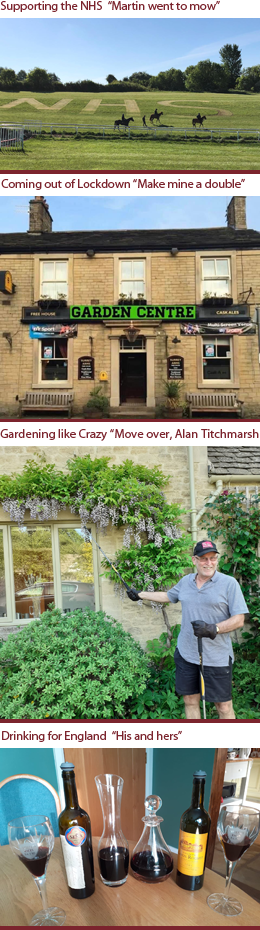
On a purely personal note, my wife and I have actually enjoyed the “staycation” of lockdown. There has been no rushing around the country and our mileage has never been lower. We’ve stayed well and healthy, with daily exercise burning off the calories from some fine wine tasting. The garden has never looked better. Finally, we’re lucky that some of our trainers have gone into overdrive on communication and there have been some magnificent photos and videos in circulation. Particularly well done to Martin Keighley in this regard as his videos are a work of art. Definitely a key part of keeping owners motivated, engaged and connected to the sport.


I am always interested to hear your views so please do leave a comment. If you can't see the comment box at the bottom of this post then navigate to the post using the right hand navigation or click here > and scroll to the bottom of the page. Look forward to hearing your views. Thanks very much for sharing them.