Showing posts with label prize-money. Show all posts

Monday, 1 June 2020

“Under Starter’s Orders … and We’re Off” (Hopefully). Racing Resumes and Everyone is Thrilled, but Now the Real Challenges Begin for British Racing.


Today racing is highly likely to get under way again at Newcastle, and it will be the first race meeting since the sport was closed down after 17th March. Once the seriousness of the pandemic is over, there will probably be a racing quiz question to name the final horse to win before lockdown – it came from the yard of one of our trainers, Charlie Longsdon, and was Glencassley, a 5yo in a Class 5 bumper, ridden by Aidan Coleman, and winning the princely sum of £2,599.20. Rarely will a Class 6 mile handicap at Newcastle have received so much attention, and doubtless huge viewing figures and betting investments. May everything go smoothly and safely.
British Racing has not had a particularly good reputation in the past for burying its differences, collaborating and co-operating, but the Resumption of Racing Group led by the BHA has excelled over the last few months and the way in which they have tackled the complexities and challenges of getting racing back on the road has been exemplary. Multiple work streams were launched, tasks prioritised and allocated to lead individuals and then the highly detailed race planning, reprogramming and creation of safety protocols were addressed in a thoroughly professional and robust manner. Everyone in the sport should take their hats off to the “Gang of Four”, namely Brant Dunshea, Chief Regulatory Officer; Dr. Jerry Hill, Chief Medical Adviser; Ruth Quinn, Director of International Racing and Racing Development; and Richard Wayman, Chief Operating Officer, for all their hard work while managing successfully to keep the stakeholders on board and the government supportive of racing’s resumption, albeit behind closed doors. More radical change has been driven forward over this couple of months of crisis than would have been achieved in years under a less collaborative way of working.

There are many messages to take out of this period, and a key learning is for racing to continue with this collaborative and far more proactive style of working … not least because the really hard work now has to commence. The implementation of the Resumption of Racing Plan doesn’t mark the end of the activity, but the beginning of the far more complex Recovery of Racing Plan. There is a huge challenge for the sport over the next few years as it is inevitable that there will be contraction in ownership ranks, racecourse attendances, trainers, stable staff and all the other participants in “racing’s ecosystem”. The unfortunate parallel I believe is to look at the impact of the financial crisis in 2008 / 2009. In the following six years there was a straight decline every year in the number of owners and horses in training. In total 17% of owners quit the sport and the horse population contracted by 11%. The bloodstock industry almost collapsed, with the middle and lower market horses almost impossible to sell. The financial impact of this on the whole sport was huge and ran into many millions of pounds of lost investment. Why should it be any different after the pandemic crisis? The global economy may have been pumped up with liquidity, but two recent quotations show the crisis that is coming. “We are likely to face a severe recession, the likes of which we haven’t seen … it’s not obvious there will be an immediate economic bounce-back”, Rishi Sunak, Chancellor. Sir Howard Davies, Chairman of RBS, said: “Three or four weeks ago, the assumption was that there was a pent-up economy desperate to get out. All it needed was the government to say, ‘the water’s not too cold’, and we’d jump back in. Now we’re realising there are all kinds of friction points, which means a V-shaped recovery is much less plausible. The recovery is going to be very slow.”

A fundamental question therefore for our sport is whether there is any consideration at all even being given at the moment to a Recovery of Racing Plan. An immediate short-term plan is essential if owners are to be motivated to remain in the sport and invest in future racehorses. It is only too easy to imagine many owners deciding to suspend or terminate their commitment to invest, and the results of the sales season will confirm or disprove that statement. My challenge would be for the industry to start the first phase of a plan from 1st June to the final day of Tattersalls Book 4 Yearling Sale on 17th October. What should be done in that 139 days? Once racing is through that period, it then needs to drill down into a three-year Recovery and Growth Plan. Sorry to sound so pessimistic but without this, I believe a very serious economic crisis lies ahead for the sport.

Very encouragingly, the seeds of recovery can be found in the way of working of the Resumption of Racing Group. The whole race programme, fixture list and rescheduling of the Classics has been a huge undertaking and achieved, successfully, in less than ten weeks. it is not an over-statement to say that in normal times this wouldn’t have occurred in ten years. That sort of radical change needs to become the keynote for the recovery plan. Another example – something that Owners for Owners has been proposing for ages – is the need to rebalance prize-money from the top tier of the sport to the grass roots. Faced with a considerable reduction in prize-money and levy funding due to the negative impact on racing income of racing behind closed doors, reduced fixtures and lost media rights, it was inevitable that prize-money would have to be slashed, but rather than spread the pain equally the BHA has done everything possible to support the grass-roots. The pain is being felt most at the top of the sport, as the chart below for Flat prize-money clearly shows. 84% of all horses in training on the Flat race at Class 4 or below, with 46% of the horse population at Class 6 level where the drama and clamour of the sport is hardly evident. This realignment of prize-money ought to be a permanent feature and be one pillar of the recovery plan.

Minimum Prize Values Introduced from 1st June 2020


Class 2-year-old 3-year-old-plus
Old Minimum Value New Minimum Value % Old Minimum Value New Minimum Value %
1(G1) £ 150,000 £  75,000 50% £  200,00 £  100,000 50%
1(G1) £  65,000 £  37,000 57% £   90,000 £    52,000 58%
1(G3) £  40,000 £  25,500 64% £   60,000 £    37,000 62%
1(Lstd) £  25,500 £  17,500 69% £   37,000 £    25,500 69%
2(H) £         - £         -
£   45,000 £    40,000 89%
2 £  14,000 £  11,500 82% £   19,000 £    15,000 79%
3 £  10,000 £   9,000 90% £   11,500 £    10,400 90%
4* £    6,100 £   6,100 100% £     7,250 £      7,250 100%
5* £    4,500 £   5,400 120% £     4,500 £      5,400 120%
6* £    3,500 £   4,300 123% £     3,500 £      4,300 123%


The ownership experience from June onwards is likely to be critical in owner retention. Unfortunately at the moment owners are unable to attend racecourses and see their horses in action, frustrated at the difficulties of actually getting horses into races with huge entries, forbidden to attend social gatherings with fellow owners and restricted by trainers from access to yards while having to follow all the required social distancing measures. The bottom line is that the bills remain the same, but the ownership experience is significantly curtailed. That is the demotivating reality that confronts the owners of racehorses. It is absolutely vital in the short term 139-day plan that racing, and particularly racecourses and trainers, come up with compensatory benefits to ensure that owners remain sufficiently motivated and connected to the sport to continue in it. This will be the subject of the next blog, by which time it is to be hoped that some encouraging initiatives will be under way.

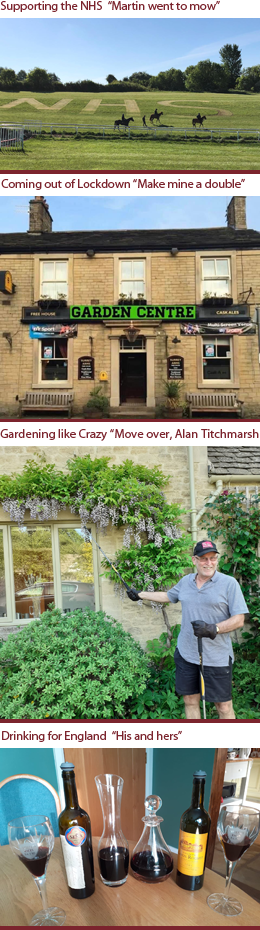
On a purely personal note, my wife and I have actually enjoyed the “staycation” of lockdown. There has been no rushing around the country and our mileage has never been lower. We’ve stayed well and healthy, with daily exercise burning off the calories from some fine wine tasting. The garden has never looked better. Finally, we’re lucky that some of our trainers have gone into overdrive on communication and there have been some magnificent photos and videos in circulation. Particularly well done to Martin Keighley in this regard as his videos are a work of art. Definitely a key part of keeping owners motivated, engaged and connected to the sport.


I am always interested to hear your views so please do leave a comment. If you can't see the comment box at the bottom of this post then navigate to the post using the right hand navigation or click here > and scroll to the bottom of the page. Look forward to hearing your views. Thanks very much for sharing them.


Monday, 1 July 2019

Why it’s Time for British Racing to Develop a UK-Wide Syndicate Strategy to Grow and Retain Owners for the Sport


In the last blog, a number of priorities were flagged up for the new Chair of the BHA, Annamarie Phelps, who took up the leadership position on 1st June. I’m sure by now she’s only too aware of the big challenges facing racing and the key questions that need to be raised, and then answered. So for example, what are the major sources of funds that will guarantee the viability of the sport (the last blog echoed Steve Harman’s call for action with regard to the next stage of Levy development); does the expansion of the race programme continue (as the new CEO of the Racecourse Association advocates), or is it reduced (as the Horsemen’s Group would probably prefer); what are the priorities and funding implications of the new ownership strategy being developed by the Racehorse Owners Association; what are the ethical and integrity issues that need to be addressed as part of risk mitigation for the sport; and how are the problems of recruitment, retention and welfare of racing staff to be resolved? Doubtless there are also many other pressing concerns for Annamarie’s first 100 days.

All those questions are relevant for someone taking a top-down perspective on racing. Obviously in Owners for Owners we’re immersed in the day-to-day of grass-roots owning and syndication. However, in this blog we’re trying to make the link between the top-down and bottom-up perspectives in the context of syndication.

We’re members of the Racehorse Syndicates Association, which is actively promoting ongoing improvements in the ownership experience so that syndicate members are attracted into the game and retained within it. As part of that promotion, several important and little-appreciated facts are being publicised. It should be said that the numbers are only estimates, as absolutely no-one anywhere in racing has accurate facts and data on the importance and contribution of syndication to British Racing …. and that says everything, doesn’t it!

  • Insight 1: there are 2,500 syndicate organisers in the UK. Assuming ten owners on average per syndicate, that is 25,000 owners. They are the unknown stakeholders of British Racing.
  • Insight 2: the total number of horses owned by syndicate organisers in the UK is estimated to be 5,000. Assume that the expenditure with trainers, vets, jockeys etc. is £20,000 per year, that is £100m contribution to the racehorse training industry.
  • Insight 3: if we assume that the syndicate organisers replace these horses every other year, and the average bloodstock price is £30,000, then the income for the bloodstock industry is £75m.
  • Insight 4: the running of syndicate horses clearly makes an important contribution to competitive racing, betting turnover, levy and media rights. We have no knowledge of the quantum of this, but let’s estimate that it is £25m.
  • Insight 5: if 2,500 syndicate organisers and the 25,000 owners is correct, and these owners visit racecourses once a month, spending £50 on each visit, then that is a £30m income for racecourses across the country from syndicates.
  • Total annual contribution to British Racing from syndication is £230m.

At the moment, British Racing has no strategy focused on this important sector. As already mentioned, it has no meaningful data. It has little knowledge of the syndicate members, nor their needs and requirements. Faced with what is in effect a “black hole”, there must be a considerable opportunity to grow significantly the syndication of racehorses in the sport. In the past there have been one or two rather trivial attempts to promote syndication, of which a good example is the flawed “In the Paddock” web site that doesn’t even work properly. It all looks very amateurish and half-hearted.

Everyone in racing surely buys into the expansion of syndication. However, to do that there are a few much wider issues that need to be addressed, as highlighted in the diagram below. The left pyramid shows that there is an over-concentration of money at the top, while the grass-roots foundation, which is where the vast majority of syndicates are operating, is crumbling, with many trainers and owners struggling financially. One solution would be to change the ratio of prize-money between the top and the bottom of the pyramid. As a timely example, although we adore Royal Ascot as an event with all its pomp and circumstance, it embodies the elitist nature of the sport. That is not an argument to change Royal Ascot, but we believe that far too much money is concentrated into the top races, and therefore goes to the top owners, trainers and breeders. We need more money for the grass roots. In the right hand diagram, the point is also emphasised that any realignment of prize-money should flow to the races that are the most competitive and generate the greatest betting levy. I wonder whether that data is readily available ….. or is it another black hole?

On a personal note, we’re involved with the RSA in the launch of the first-ever Syndicate Sunday at Stratford-on-Avon Racecourse on Sunday 21st July, and hoping it will be really well supported by trainers and syndicators across the country. We’re determined to celebrate the success of syndication ….. and raise a glass to its expansion.
Fundamentally Changing the Ownership & Prize-Money Pyramid


I am always interested to hear your views so please do leave a comment. If you can't see the comment box at the bottom of this post then navigate to the post using the right hand navigation or click here > and scroll to the bottom of the page. Look forward to hearing your views. Thanks very much for sharing them.

Thursday, 1 February 2018

“Money, Money, Money, it’s a Rich Man’s World” (And, Alas, a Poor Man’s): Moral Dilemmas of FOBTs and Bloodstock Sales


In last month’s blog I had a look at the prices vs. returns of NH horses at the Tattersalls’ Cheltenham Sale in May 2016. The total spend including purchasing the horses and then training them came out at £1,922,300. Yet they only went on to win five races in total, and the measly prize-money of £63,169, at an average per horse of £6,317. That gave a total return on investment (or as I like to refer to it, Return on Ownership) of a staggeringly dismal 3.2%.

This struck a chord with a number of blog readers who sent me similar examples, including Tattersalls’ Book 1, October 2015. I’m sure you can guess the record of the top 10 there as well. Many of you, I know, will shrug your shoulders and say that if rich people want to waste such prodigious amounts of money, that’s up to them. But before I list out those lots, why not just reflect on the moral dilemma that is now facing politicians and in turn British Racing over Fixed Odds Betting Terminals (FOBTs).

The Department for Culture, Media & Sport launched a review 15 months ago in response to widespread concerns about the addictive nature of FOBTs. This culminated in a decision in October 2017 to cut the maximum stake from £100 to somewhere between £2 and £50. The Department then launched a 12-week consultation period which came to an end last month. The review also encompassed wider socially responsible measures to protect the vulnerable. This is definitely a case of a poor person’s world.

The Sunday Times led a scoop front page announcing that the Government was going to cut the FOBT stakes to a maximum of £2. Many of you, I know, will strongly agree with this. However it didn’t take long for the bookmaking industry and British Racing to examine the impact of a £2 maximum stake. Whether the figures are accurate or not I don’t know, but Martin Cruddace, boss of Arena Racing Company, caught the headlines when he forecast that an FOBT limit reduction would lead to 4,000 to 5,000 betting shop closures. Some took a more cautious view that maybe only 3,000 shops would close, but apparently the average shop pays £30,000 for media rights so the loss of income could easily be in excess of £90 million per annum with a view that, in turn, at least £55 million could be axed from prize-money.

Clearly, this is a very sobering story and it cannot be easy to deal with. Racing needs every pound that it can get its hands on, but surely not through the “crack cocaine” of FOBTs. A moral dilemma indeed.

In this context, the lunacy of bloodstock prices at sales such as Tattersalls almost appear like comic relief. Here are the top 10 from October 2015.

Lot 304, Dubawi – Loveisallyouneed. £2,205,000. Hasn’t raced, prize-money zero.

Lot 30, Galileo – A Z Warrior. £1,365,000. Named Key To My Heart. Won twice, prize-money £47,652.

Lot 43, Galileo – Alluring Park. £1,312,500. Named Douglas Macarthur. Won twice, prize-money £122,189.

Lot 255, Galileo – Jacqueline Quest. £1,260,000. Named World War. Won once, prize-money £26,068.

Lot 254, Oasis Dream – Izzy Top. £1,155,000. Named Dreamfield. Won twice, prize-money £12,291.

Lot 293, Galileo – Like A Dame. £1,050,000. Named Longing. Won once, prize-money £9,285.

Lot 71, Dubawi – Badee’a. £945,000. Hasn’t raced, prize-money zero.

Lot 204, Dark Angel – Folga. £866,250. Named Dirayah. Hasn’t won, prize-money £385.

Lot 439, Street Cry – Shastye. £840,000. Named Secret Soul. Hasn’t won, prize-money £,684.

Lot 107, Oasis Dream – Caphene. £787,500. Named Watchman. Hasn’t raced, prize-money zero.

Dear, oh dear. If we add a million or so for training fees and commissions, then the ROI / Return on Ownership is 1.72% on a total prize-money of £219,554. Indeed it must be even worse than the return on FOBTs, which says something.

Just to finish on a sobering note though the gross gambling yield, i.e. the amount kept by the betting shop operators after winnings are paid out, in the year to March 2017 was £1.39 billion from traditional betting ….. and a staggering £1.86 billion from FOBTs. It will be very surprising indeed if the Government doesn’t crack down hard on these machines and in turn, bookmakers ….. and I’m afraid, on racing’s income.


I am always interested to hear your views so please do leave a comment. If you can't see the comment box at the bottom of this post then navigate to the post using the right hand navigation or click here > and scroll to the bottom of the page. Look forward to hearing your views. Thanks very much for sharing them.


Tuesday, 1 December 2015

The Row Over Horse Race Sponsorship and Why Bookmaker Behaviour Has to Change


Last Saturday was the 58th year of the oldest sponsorship in British racing in the Hennessy Gold Cup at Newbury. With the row that has now erupted over Authorised Betting Partner (ABP) status and the brinkmanship between some of the big bookmakers and British Racing, one wonders whether we will see such successful and rewarding partnerships again, or whether a permanent chasm has opened up between the parties. Encouragingly there appears to be very little sympathy for the bookmaker stance as they try to evade making a fair and sustainable contribution to the sport. Indeed, for the moment, racing and the betting public appear to be disgusted by their short-sighted and extremely selfish stance. Surely this must in turn cause substantial brand damage – not least at a time when the financial performance of some of the big bookmakers is lamentable and they are increasingly huddling together through mergers or, as some commentators have said, “propping each other up like down-and-out drunks”.

ABP status is one tool to encourage bookmakers to make a proper contribution to racing from their offshore betting turnover. The BHA estimates that our sport is losing £30m a year because of levy evasion. Some bookmakers such as Bet 365, 32 Red and Betfair are already making a voluntary contribution (and you could argue, putting themselves at a competitive disadvantage to those that are not), whereas others such as Betfred, Ladbrokes, Coral, William Hill, Skybet, 888 Sport and Paddy Power are making no or minor contributions. From 1st January 2016 bookmakers will not be able to sponsor races without being ABP accredited.

It only took a few weeks from the announcement of ABP for brinkmanship to break out, with die-hard bookies threatening to pull the plug on their sponsorship deals: Betfred with the Cheltenham Gold Cup and Haydock Sprint Cup; Ladbrokes with the World Hurdle; Coral with the all-weather championships; and William Hill with the Kempton winter festival including the King George VI. Paddy Power have indicated that it could well affect their Cheltenham sponsorship. Some have questioned the legality of ABP exclusion as a potential breach of competition law. Alas, all very predictable, as was Betfair stepping in to the sponsorship role for the Tingle Creek at Sandown as soon as 888 Sport dropped out. This row is certainly going to test the unity of the various parties.

Obviously the row is not without risk. Although the figures are a few years out of date, when Deloittes and the BHA produced their Economic Impact of British Racing in 2012, total sponsorship was £82.2m, with 7,326 races sponsored. Of this, bookmakers’ contribution was £31.8m, covering 3,018 races, or 41% of the races and 39% of the total sponsorship pot. Similarly from the BHA Fact Book 2011-12, the breakdown of prize-money in 2011 was Levy Board contribution 34%, racecourses 28%, sponsorship 20% and owners 16%. So if the bookies decide to go elsewhere with their sponsorship money and fund other sports, it will clearly damage the funding of racing and owner prize-money, at least in the short term.

Is this a risk worth taking? The over-arching principle now guiding British racing is that there must be a sustainable, commercial funding regime for the sport. Bookmaker contribution through the levy (or its replacement) is critical. As many levers of persuasion as possible need to be used to encourage, cajole or coerce bookies back to the negotiating table. The levy talks have broken down, so the ABP route is one lever that is definitely worth continuing with, particularly if the bookmakers receive a proper package of benefits as a result of signing up. Unfortunately at the moment hostility between the parties is blocking off a more collaborative search for the many mutual benefits that certainly exist. Without bookmaker behaviour changing, this could still have the makings of a zero sum game. It is vital that the debate shifts as quickly as possible on to innovation and growing a bigger betting pie while making racing even more attractive to the sports-going public. This can only happen through commercial collaboration.

One benefit that may come out of the row is a complete re-think of racing sponsorship. From the bookmakers’ side a lot of it looks extremely pedestrian and little more than a naming and badging exercise for races. From the racing side the product proposition is generally tedious from Sunday through to Friday, with insufficient thought and co-ordinated planning being given to framing fixtures and races that genuinely excite the consumer and, in turn, maximise betting revenue. Admittedly there are the high points of Cheltenham, Aintree, Epsom, Ascot and Goodwood but thousands of races are instantly forgettable as, indeed, are their sponsors.

And finally, a strong case can be made for looking way beyond traditional race sponsorship by bookies. Racing has become inertial, with chronic under-representation of leading British and global companies in our sport. From the 2012 data, food and drink companies only put in £6.5m of sponsorship, while the financial services sector was even less visible with £4.3m. A massive mind-set change is needed from sponsoring races to sponsoring events and experiences. Marketing gurus argue for “the integration of sponsorship platforms”, “co-creation of brands between companies and consumers” and “customers acting as ambassadors”. Watching Neanderthal bookies locking horns with Great British Racing in ultimately self-defeating rows over financial contribution, it is easy to despair. However it would be of real benefit to the industry if a search for new sponsorship in turn brought in a new generation of companies and dynamic leaders from other sectors with an enthusiasm to transform the whole way in which racing is presented to the broader betting and racegoing public.

In the meantime, I enjoyed raising a glass of fine brandy to the Hennessy winner.


I am always interested to hear your views so please do leave a comment. If you can't see the comment box at the bottom of this post then navigate to the post using the right hand navigation or click here > and scroll to the bottom of the page. Look forward to hearing your views. Thanks very much for sharing them.