Showing posts with label investment. Show all posts

Monday, 1 June 2020

“Under Starter’s Orders … and We’re Off” (Hopefully). Racing Resumes and Everyone is Thrilled, but Now the Real Challenges Begin for British Racing.


Today racing is highly likely to get under way again at Newcastle, and it will be the first race meeting since the sport was closed down after 17th March. Once the seriousness of the pandemic is over, there will probably be a racing quiz question to name the final horse to win before lockdown – it came from the yard of one of our trainers, Charlie Longsdon, and was Glencassley, a 5yo in a Class 5 bumper, ridden by Aidan Coleman, and winning the princely sum of £2,599.20. Rarely will a Class 6 mile handicap at Newcastle have received so much attention, and doubtless huge viewing figures and betting investments. May everything go smoothly and safely.
British Racing has not had a particularly good reputation in the past for burying its differences, collaborating and co-operating, but the Resumption of Racing Group led by the BHA has excelled over the last few months and the way in which they have tackled the complexities and challenges of getting racing back on the road has been exemplary. Multiple work streams were launched, tasks prioritised and allocated to lead individuals and then the highly detailed race planning, reprogramming and creation of safety protocols were addressed in a thoroughly professional and robust manner. Everyone in the sport should take their hats off to the “Gang of Four”, namely Brant Dunshea, Chief Regulatory Officer; Dr. Jerry Hill, Chief Medical Adviser; Ruth Quinn, Director of International Racing and Racing Development; and Richard Wayman, Chief Operating Officer, for all their hard work while managing successfully to keep the stakeholders on board and the government supportive of racing’s resumption, albeit behind closed doors. More radical change has been driven forward over this couple of months of crisis than would have been achieved in years under a less collaborative way of working.

There are many messages to take out of this period, and a key learning is for racing to continue with this collaborative and far more proactive style of working … not least because the really hard work now has to commence. The implementation of the Resumption of Racing Plan doesn’t mark the end of the activity, but the beginning of the far more complex Recovery of Racing Plan. There is a huge challenge for the sport over the next few years as it is inevitable that there will be contraction in ownership ranks, racecourse attendances, trainers, stable staff and all the other participants in “racing’s ecosystem”. The unfortunate parallel I believe is to look at the impact of the financial crisis in 2008 / 2009. In the following six years there was a straight decline every year in the number of owners and horses in training. In total 17% of owners quit the sport and the horse population contracted by 11%. The bloodstock industry almost collapsed, with the middle and lower market horses almost impossible to sell. The financial impact of this on the whole sport was huge and ran into many millions of pounds of lost investment. Why should it be any different after the pandemic crisis? The global economy may have been pumped up with liquidity, but two recent quotations show the crisis that is coming. “We are likely to face a severe recession, the likes of which we haven’t seen … it’s not obvious there will be an immediate economic bounce-back”, Rishi Sunak, Chancellor. Sir Howard Davies, Chairman of RBS, said: “Three or four weeks ago, the assumption was that there was a pent-up economy desperate to get out. All it needed was the government to say, ‘the water’s not too cold’, and we’d jump back in. Now we’re realising there are all kinds of friction points, which means a V-shaped recovery is much less plausible. The recovery is going to be very slow.”

A fundamental question therefore for our sport is whether there is any consideration at all even being given at the moment to a Recovery of Racing Plan. An immediate short-term plan is essential if owners are to be motivated to remain in the sport and invest in future racehorses. It is only too easy to imagine many owners deciding to suspend or terminate their commitment to invest, and the results of the sales season will confirm or disprove that statement. My challenge would be for the industry to start the first phase of a plan from 1st June to the final day of Tattersalls Book 4 Yearling Sale on 17th October. What should be done in that 139 days? Once racing is through that period, it then needs to drill down into a three-year Recovery and Growth Plan. Sorry to sound so pessimistic but without this, I believe a very serious economic crisis lies ahead for the sport.

Very encouragingly, the seeds of recovery can be found in the way of working of the Resumption of Racing Group. The whole race programme, fixture list and rescheduling of the Classics has been a huge undertaking and achieved, successfully, in less than ten weeks. it is not an over-statement to say that in normal times this wouldn’t have occurred in ten years. That sort of radical change needs to become the keynote for the recovery plan. Another example – something that Owners for Owners has been proposing for ages – is the need to rebalance prize-money from the top tier of the sport to the grass roots. Faced with a considerable reduction in prize-money and levy funding due to the negative impact on racing income of racing behind closed doors, reduced fixtures and lost media rights, it was inevitable that prize-money would have to be slashed, but rather than spread the pain equally the BHA has done everything possible to support the grass-roots. The pain is being felt most at the top of the sport, as the chart below for Flat prize-money clearly shows. 84% of all horses in training on the Flat race at Class 4 or below, with 46% of the horse population at Class 6 level where the drama and clamour of the sport is hardly evident. This realignment of prize-money ought to be a permanent feature and be one pillar of the recovery plan.

Minimum Prize Values Introduced from 1st June 2020


Class 2-year-old 3-year-old-plus
Old Minimum Value New Minimum Value % Old Minimum Value New Minimum Value %
1(G1) £ 150,000 £  75,000 50% £  200,00 £  100,000 50%
1(G1) £  65,000 £  37,000 57% £   90,000 £    52,000 58%
1(G3) £  40,000 £  25,500 64% £   60,000 £    37,000 62%
1(Lstd) £  25,500 £  17,500 69% £   37,000 £    25,500 69%
2(H) £         - £         -
£   45,000 £    40,000 89%
2 £  14,000 £  11,500 82% £   19,000 £    15,000 79%
3 £  10,000 £   9,000 90% £   11,500 £    10,400 90%
4* £    6,100 £   6,100 100% £     7,250 £      7,250 100%
5* £    4,500 £   5,400 120% £     4,500 £      5,400 120%
6* £    3,500 £   4,300 123% £     3,500 £      4,300 123%


The ownership experience from June onwards is likely to be critical in owner retention. Unfortunately at the moment owners are unable to attend racecourses and see their horses in action, frustrated at the difficulties of actually getting horses into races with huge entries, forbidden to attend social gatherings with fellow owners and restricted by trainers from access to yards while having to follow all the required social distancing measures. The bottom line is that the bills remain the same, but the ownership experience is significantly curtailed. That is the demotivating reality that confronts the owners of racehorses. It is absolutely vital in the short term 139-day plan that racing, and particularly racecourses and trainers, come up with compensatory benefits to ensure that owners remain sufficiently motivated and connected to the sport to continue in it. This will be the subject of the next blog, by which time it is to be hoped that some encouraging initiatives will be under way.

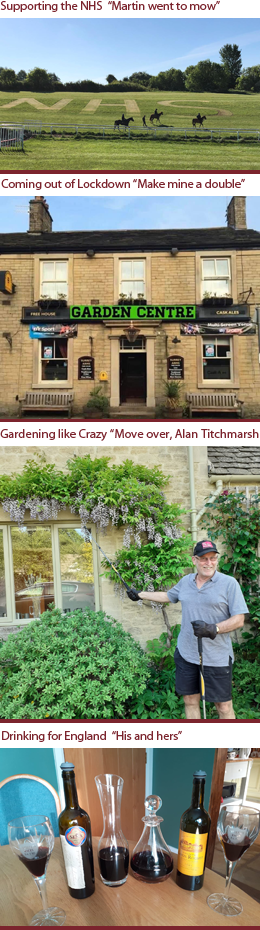
On a purely personal note, my wife and I have actually enjoyed the “staycation” of lockdown. There has been no rushing around the country and our mileage has never been lower. We’ve stayed well and healthy, with daily exercise burning off the calories from some fine wine tasting. The garden has never looked better. Finally, we’re lucky that some of our trainers have gone into overdrive on communication and there have been some magnificent photos and videos in circulation. Particularly well done to Martin Keighley in this regard as his videos are a work of art. Definitely a key part of keeping owners motivated, engaged and connected to the sport.


I am always interested to hear your views so please do leave a comment. If you can't see the comment box at the bottom of this post then navigate to the post using the right hand navigation or click here > and scroll to the bottom of the page. Look forward to hearing your views. Thanks very much for sharing them.


Wednesday, 1 August 2018

Have You Heard About the New Ownership Strategy for British Racing? I Bet You Haven’t


Towards the end of July full details of the 2019 Fixture List were published with all the powers that be in British Racing claiming it as a great example of the tripartite structure working together well to balance the different requirements of the sport and the betting industry. A quick summary is that there will be a record 1,511 meetings next year, three more than in 2018: 951 Flat fixtures, 596 Jumps; 23% of the total will be all-weather meetings with floodlit fixtures January to April starting at 4pm (including 20 at Southwell); there will be a three-week gap between the Cheltenham and Aintree Festivals. It was very easy to access and while not everyone agrees with the precedence of quantity over quality, at least it was an announcement with transparency and lots of detail. Well done to all concerned.

Unfortunately the so-called Ownership Strategy for British Racing appears to be at the other end of the scale for transparency, detail and ease of access. Indeed, has anyone actually heard of it? If you are an assiduous reader of the Racehorse Owners’ Association Annual Report 2017/18 you will have found a couple of pages on it, but it is devilish tricky to find out any more. Your diligent Owners for Owners blog writer has been sleuthing the case for almost a year now, with repeated email requests to the chief executive of the ROA, Charlie Liverton, but alas, to no avail. There is a total refusal to provide any meaningful insights or detail about the strategy, which is pretty scandalous because significant industry funds (almost £1m) have been committed to the strategy, its promotion and marketing, with the ROA as the lead body on behalf of the whole industry.

Owners for Owners has a particular interest in ownership strategy, not least because I was one of the unpaid volunteers who sat on the original strategy pillar team launched by the BHA, and spent a considerable amount of time examining ownership issues and requirements with substantial input going into the business case that proposed 1,000 extra horses in British Racing by 2020. That clearly counts for nothing with the ROA. You would have thought that my involvement in the pillar team would have guaranteed access to the latest strategy, and that is before you consider the large investment that OfO has made in bloodstock in recent years – indeed under various banners we are managing almost 30 horses in training and a substantial network of owners. Ironic that this doesn’t seem to count for anything with the ROA either. And then finally I’m on the committee of the Racehorse Syndicates Association which wants to work on an “inclusive” and “collaborative” basis with other stakeholders in British Racing to ensure that ownership strategies properly reflect the needs and demands of the ever-increasing numbers involved in syndicates. I put “inclusive” and “collaborative” in inverted commas because these are words much used across the tripartite structure of the BHA, Horsemen’s Group and Racecourse Association. With the ROA being central to the Horsemen’s Group, it is again somewhat surprising that they are not prepared to apply the same principles and values in their everyday dealings with owners whom they purport to represent.

Here is a summary of what the ROA terms their “development of a collaborative and inclusive ownership strategy for British Racing”. The ROA project highlights “the continued importance of the role of owners within racing. The strategy will give owners an enhanced brand and identity, emphasising their role as supporters of the sport in so many different ways.”

Apparently four work streams have been developed within the framework of the Ownership Strategy for British Racing:
  • Retention: “the project focuses on the key elements of retention of existing owners.”
  • Ownership Promotion: “investment in the development of a united identity for ownership will open the door to further simplification and streamlining of the ownership journey.”
  • Trainers: “a key element of the project relating to trainers is about enhancement of the service and the improvement of information provided by trainers for owners.”
  • Racecourses: “this work stream addresses owners’ racecourse experience on a number of levels. There will be a focus on creating minimum racecourse standards and assisting courses to deliver these”.
Nothing at all wrong with those four work streams. Bearing in mind that they have been described in a report dated 2017/18, then presumably all the different facets of the strategy have now been developed. What I am trying to find out are the specifics, i.e. exactly what initiatives are going to be launched, by whom, at what cost and by when, to achieve what specific goals? It is true that the ROA does flag up a number of goals, but they are far too woolly.

When I was a management consultant I was working with major companies where the problem wasn’t a lack of strategies, but too many. You would often find hundreds of strategies but scant evidence of their successful implementation. Indeed while I was working with one international bank they even had a strategy to reduce the number of strategies!! Seeing the rather comic side of this, I used to refer to “Yeti strategies” – much talked about, never seen. I do hope that isn’t the case with the one that Charlie Liverton is leading.

The intention after this blog is to approach all the leading executives across the tripartite structure, namely Steve Harman, Nick Rust, Richard Wayman, Charlie Liverton, Philip Freedman, Stephen Atkin and Rupert Arnold and see if they can help me obtain more details of the practical implications of this strategy for owners.

I’ll keep you posted through this blog!


I am always interested to hear your views so please do leave a comment. If you can't see the comment box at the bottom of this post then navigate to the post using the right hand navigation or click here > and scroll to the bottom of the page. Look forward to hearing your views. Thanks very much for sharing them.