Showing posts with label British Racing. Show all posts

Sunday, 1 November 2020

Sole Leadership of an Industry-Wide Ownership Strategy Needs to be Taken Away from the Racehorse Owners Association

Regular readers of this blog and also the one on www.keepownersinracing.com will know that there has been a critical need for an industry-wide ownership strategy, structured in a way that incentivises and motivates owners to remain in the sport, while attracting new ones. Back in 2017, it was agreed by racing’s leadership that this strategy would be developed by the Racehorse Owners Association, but with collaborative work groups linking together all the important players so that there would be a coherent approach to ownership, and one that would be able to launch major initiatives impacting racecourses, trainers, owner-breeders, syndicators and the whole ownership population. The process that the ROA has pursued, under the leadership of their chief executive Charlie Liverton, has unfortunately been an heroic failure, despite its being funded to the tune of £1.2m by the Horserace Betting Levy Board. Almost no-one in the industry can tell you what the Ownership Strategy actually means, there is no commitment to it (not least because no-one knows what it is) and the strategy process would fail any test of good design. Indeed, the leading academic in this area, Richard Rummelt, of the University of Southern California, describes many strategies as “garbage”, full of “fluff and flannel” and laundry-lists of “statements of desire” with no chance whatsoever of being implemented. He could have been reading the bumf put out by the ROA.

In the most recent blogs on KOIR, we have come to the conclusion that the Ownership Strategy needs to be taken away from Charlie Liverton and handed back to a cross-industry working group of the committed and the competent. We would go even further than that, calling for his replacement. Here are two blogs that convey the argument and the flavour of what we are advocating.

Ownership Strategy, Part 2 – Testing and Tracing the ROA’s Six-Point Covid Plan

What has your reaction been to the last eight months? Frustration on seemingly incoherent and inconsistent policy; irritation at the endless procrastinations and prevarications; anger at constant ineptitude in implementation of initiatives, “too little and too late”; amazement at the fortunes being paid out to armies of management consultants; incredulity at the disarray of high-ranking leaders and their inability to lead; wonderment at the endless TLAs (three-letter acronyms) of bureaucracies and working groups producing ever more confusing and contradictory reports? All compounded by a lack of scrutiny of actions, results and accountabilities. And that’s just the Racehorse Owners Association and their non-existent / inept leadership of an Industry Ownership Strategy that was promised back in 2017 (we’ll pass over your views about Dido Harding and Test and Trace).

You’ll know from the Keep Owners in Racing blogs that we campaigned hard for the release of a meaningful Ownership Strategy. We understand that over £1.2m was invested in it through funds from the Horserace Betting Levy Board. Portas Consultants supported it, and even at bargain basement rates (for consultants) of £1,000 per day, that represents at least five years of effort. It seems reasonable to expect strategic outputs of the highest quality for that investment. Indeed, my co-author Ged Shields has been expecting a “Sistine Chapel of an ownership strategy”, bearing in mind how long it has taken and the cost involved. We’ve been requesting sight of the Ownership Strategy for a long time, and Ged and I joke that its publication has been delayed more times than the latest James Bond movie.

Back on 25th August, when Nick Rust announced the nine goals of his Recovery Plan, it was promised “within weeks”. The lockdown was ordered by the Prime Minister on 23rd March and we’re now 220 days on from that momentous announcement. Finally, on 28th October the ROA released a six-point action plan aimed at retaining owner investment during the ongoing Covid-19 crisis. Dear oh dear! Such a long wait for so little substance. Few meaningful initiatives; a complete absence of reference to the £1m+ funding exercise with Portas; no project management structure to design and implement actions; just lots more words and waffle, rather than solutions.

Reluctantly, we’ve come to the conclusion that it’s time to take the sole leadership of this strategy away from the chronically under-achieving ROA. For the good of the sport, it is absolutely vital that a task force of the committed and capable take charge immediately of the number one priority of retaining owners. As far as the CEO, Charlie Liverton, is concerned – sink him, park him, move him or sack him. Just move this prime blocker away from the strategy and stop the ongoing damage. Put him out of his misery.

We said in Blog 24 that “We’ll be Back”. I don’t think we expected to return quite so quickly. We’re determined to do everything possible to drive significant change in the leadership and governance of the Ownership Strategy. Stay tuned!

What Did the Romans Ever Do For Britain – or the ROA, For That Matter?

One of my favourite sketches from Life of Brian is the one where a bunch of conspirators is being challenged by John Cleese to denounce the Romans. The repeated refrain of “What have the Romans done for us?” is interspersed with a long list including the aqueduct, sanitation, roads, irrigation, medicine, education, health, wine, baths, public order and peace. Not a bad portfolio of benefits; “But apart from that, what have they done for us?”

Being a rather irreverent fellow, I was wondering what conclusions I would come to if I raised the same question about the Racehorse Owners Association. At one level you can regard them almost as a hospitality organisation or members’ club setting up social events, visits and marquees on big racedays where aged members can escape the elements and at least sit down in a little more comfort than is often provided by the racecourses. “But apart from that ….?” They produce the Owner Breeder magazine, offer third party liability insurance cover, discounts on BHA fees, free priority parking at the races, the racecourse admission scheme, owner sponsorship, occasional ROA owners’ jackpots and similar types of benefit.

Quite a good set of offerings, and by focusing on them they have attracted 8,000+ members at an annual sub of a couple of hundred pounds. Their annual turnover in 2019/20 was £2.6m, although they had a deficit of £222k.

“But apart from that ….?” What else do they do? They have certainly been in existence a long time, with three themes over the decades consistently receiving some focus: pressure for better minimum prize-money (hardly a success), trying to establish a credible long-term financial plan for racing (now in tatters), and working for the common good and leaving the factionalism of the past behind it (not sure that has been the case over the last few years, judging by ROA outbursts in the Racing Post).

A central question is whether they are genuinely representative of owners, and whether they have sufficient legitimacy to have taken charge of an Ownership Strategy which has not yet made its appearance despite being funded by £1.5m from the Horserace Betting Levy Board and the Racing Foundation. As we worked through the 100-day Keep Owners in Racing campaign, many of the individuals we’ve interviewed expressed strongly critical views about the endless delays and inadequate involvement in the framing of what should have been a genuinely cross-industry strategy. This has certainly damaged the credibility of the ROA and its leadership.

When Life of Brian was released in late 1979, its satire was deemed to be very controversial – so much so that it was prohibited in countries such as Ireland and Norway. This notoriety was a godsend for marketing, with posters apparently appearing in Sweden that read: “So funny it was banned in Norway”! While the ROA wouldn’t have gone that far, I’m sure they would have preferred it if Keep Owners in Racing had not banged the drum for owners with such tenacity. Never mind, while we’re waiting for the promised land of the Ownership Strategy we can at least whistle along to Look on the Bright Side of Life as ownership numbers and investment start to plummet.


I am always interested to hear your views so please do leave a comment. If you can't see the comment box at the bottom of this post then navigate to the post using the right hand navigation or click here > and scroll to the bottom of the page. Look forward to hearing your views. Thanks very much for sharing them.


Monday, 1 June 2020

“Under Starter’s Orders … and We’re Off” (Hopefully). Racing Resumes and Everyone is Thrilled, but Now the Real Challenges Begin for British Racing.


Today racing is highly likely to get under way again at Newcastle, and it will be the first race meeting since the sport was closed down after 17th March. Once the seriousness of the pandemic is over, there will probably be a racing quiz question to name the final horse to win before lockdown – it came from the yard of one of our trainers, Charlie Longsdon, and was Glencassley, a 5yo in a Class 5 bumper, ridden by Aidan Coleman, and winning the princely sum of £2,599.20. Rarely will a Class 6 mile handicap at Newcastle have received so much attention, and doubtless huge viewing figures and betting investments. May everything go smoothly and safely.

British Racing has not had a particularly good reputation in the past for burying its differences, collaborating and co-operating, but the Resumption of Racing Group led by the BHA has excelled over the last few months and the way in which they have tackled the complexities and challenges of getting racing back on the road has been exemplary. Multiple work streams were launched, tasks prioritised and allocated to lead individuals and then the highly detailed race planning, reprogramming and creation of safety protocols were addressed in a thoroughly professional and robust manner. Everyone in the sport should take their hats off to the “Gang of Four”, namely Brant Dunshea, Chief Regulatory Officer; Dr. Jerry Hill, Chief Medical Adviser; Ruth Quinn, Director of International Racing and Racing Development; and Richard Wayman, Chief Operating Officer, for all their hard work while managing successfully to keep the stakeholders on board and the government supportive of racing’s resumption, albeit behind closed doors. More radical change has been driven forward over this couple of months of crisis than would have been achieved in years under a less collaborative way of working.

There are many messages to take out of this period, and a key learning is for racing to continue with this collaborative and far more proactive style of working … not least because the really hard work now has to commence. The implementation of the Resumption of Racing Plan doesn’t mark the end of the activity, but the beginning of the far more complex Recovery of Racing Plan. There is a huge challenge for the sport over the next few years as it is inevitable that there will be contraction in ownership ranks, racecourse attendances, trainers, stable staff and all the other participants in “racing’s ecosystem”. The unfortunate parallel I believe is to look at the impact of the financial crisis in 2008 / 2009. In the following six years there was a straight decline every year in the number of owners and horses in training. In total 17% of owners quit the sport and the horse population contracted by 11%. The bloodstock industry almost collapsed, with the middle and lower market horses almost impossible to sell. The financial impact of this on the whole sport was huge and ran into many millions of pounds of lost investment. Why should it be any different after the pandemic crisis? The global economy may have been pumped up with liquidity, but two recent quotations show the crisis that is coming. “We are likely to face a severe recession, the likes of which we haven’t seen … it’s not obvious there will be an immediate economic bounce-back”, Rishi Sunak, Chancellor. Sir Howard Davies, Chairman of RBS, said: “Three or four weeks ago, the assumption was that there was a pent-up economy desperate to get out. All it needed was the government to say, ‘the water’s not too cold’, and we’d jump back in. Now we’re realising there are all kinds of friction points, which means a V-shaped recovery is much less plausible. The recovery is going to be very slow.”

A fundamental question therefore for our sport is whether there is any consideration at all even being given at the moment to a Recovery of Racing Plan. An immediate short-term plan is essential if owners are to be motivated to remain in the sport and invest in future racehorses. It is only too easy to imagine many owners deciding to suspend or terminate their commitment to invest, and the results of the sales season will confirm or disprove that statement. My challenge would be for the industry to start the first phase of a plan from 1st June to the final day of Tattersalls Book 4 Yearling Sale on 17th October. What should be done in that 139 days? Once racing is through that period, it then needs to drill down into a three-year Recovery and Growth Plan. Sorry to sound so pessimistic but without this, I believe a very serious economic crisis lies ahead for the sport.

Very encouragingly, the seeds of recovery can be found in the way of working of the Resumption of Racing Group. The whole race programme, fixture list and rescheduling of the Classics has been a huge undertaking and achieved, successfully, in less than ten weeks. it is not an over-statement to say that in normal times this wouldn’t have occurred in ten years. That sort of radical change needs to become the keynote for the recovery plan. Another example – something that Owners for Owners has been proposing for ages – is the need to rebalance prize-money from the top tier of the sport to the grass roots. Faced with a considerable reduction in prize-money and levy funding due to the negative impact on racing income of racing behind closed doors, reduced fixtures and lost media rights, it was inevitable that prize-money would have to be slashed, but rather than spread the pain equally the BHA has done everything possible to support the grass-roots. The pain is being felt most at the top of the sport, as the chart below for Flat prize-money clearly shows. 84% of all horses in training on the Flat race at Class 4 or below, with 46% of the horse population at Class 6 level where the drama and clamour of the sport is hardly evident. This realignment of prize-money ought to be a permanent feature and be one pillar of the recovery plan.

Minimum Prize Values Introduced from 1st June 2020


Class 2-year-old 3-year-old-plus
Old Minimum Value New Minimum Value % Old Minimum Value New Minimum Value %
1(G1) £ 150,000 £  75,000 50% £  200,00 £  100,000 50%
1(G1) £  65,000 £  37,000 57% £   90,000 £    52,000 58%
1(G3) £  40,000 £  25,500 64% £   60,000 £    37,000 62%
1(Lstd) £  25,500 £  17,500 69% £   37,000 £    25,500 69%
2(H) £         - £         -
£   45,000 £    40,000 89%
2 £  14,000 £  11,500 82% £   19,000 £    15,000 79%
3 £  10,000 £   9,000 90% £   11,500 £    10,400 90%
4* £    6,100 £   6,100 100% £     7,250 £      7,250 100%
5* £    4,500 £   5,400 120% £     4,500 £      5,400 120%
6* £    3,500 £   4,300 123% £     3,500 £      4,300 123%


The ownership experience from June onwards is likely to be critical in owner retention. Unfortunately at the moment owners are unable to attend racecourses and see their horses in action, frustrated at the difficulties of actually getting horses into races with huge entries, forbidden to attend social gatherings with fellow owners and restricted by trainers from access to yards while having to follow all the required social distancing measures. The bottom line is that the bills remain the same, but the ownership experience is significantly curtailed. That is the demotivating reality that confronts the owners of racehorses. It is absolutely vital in the short term 139-day plan that racing, and particularly racecourses and trainers, come up with compensatory benefits to ensure that owners remain sufficiently motivated and connected to the sport to continue in it. This will be the subject of the next blog, by which time it is to be hoped that some encouraging initiatives will be under way.

On a purely personal note, my wife and I have actually enjoyed the “staycation” of lockdown. There has been no rushing around the country and our mileage has never been lower. We’ve stayed well and healthy, with daily exercise burning off the calories from some fine wine tasting. The garden has never looked better. Finally, we’re lucky that some of our trainers have gone into overdrive on communication and there have been some magnificent photos and videos in circulation. Particularly well done to Martin Keighley in this regard as his videos are a work of art. Definitely a key part of keeping owners motivated, engaged and connected to the sport.


I am always interested to hear your views so please do leave a comment. If you can't see the comment box at the bottom of this post then navigate to the post using the right hand navigation or click here > and scroll to the bottom of the page. Look forward to hearing your views. Thanks very much for sharing them.


Friday, 1 May 2020

Coming Out of Lockdown – The Resumption of Racing Appears to be Getting Nearer


Has anyone experienced an April like the one we’ve just been through? I was uncertain whether to start this blog with a small number of personal reflections, or to concentrate on the gravity of the situation and the grim news that we have all been encountering – lighter news prevailed, before the sombre.

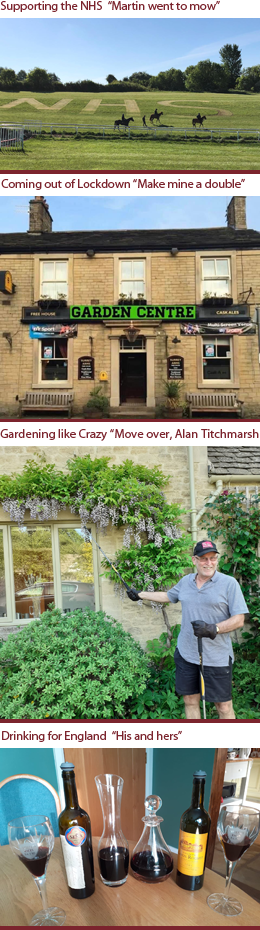
NHS rainbow sheep, Mayfair Rock’s filly foal, Luttrell Lad loving his grub, A new form of G&T, Life’s too short for bad wine
We’ll all have our own personal memories of the crisis, and for me they will be triggered in future years by the five photographs. Without any doubt (subject of course to disasters!) I’m going to come out of the lockdown in a far healthier state than when I went into it. My wife and I are having an hour’s walk around the Cotswold hills every day, and the trudge back to our house is quite steep. We’ve both enjoyed watching the newborn lambs, and our local farmer amused the village by painting “NHS” on the heaviest lamb that had been born to date, and his mum.

Earlier in the month, our mare Mayfair Rock produced her first foal, and we’re all hoping that this lovely grey filly will go on to great things. She is by Gr.1-winning Havana Grey, trained by Karl Burke, and he very generously helped us with a free nomination to this stallion, who has been well supported by breeders.

It has been very interesting to see all the various forms of communication being adopted by the racing world, not least our network of trainers, studs and pre-training yards. Several of them have really risen to the challenge of keeping owners fully informed and in touch with their horses, and I particularly want to commend Claire Hart and Martin Keighley for the almost daily flow of super photos and videos. Claire is looking after Luttrell Lad, who was due to race at Stratford, but alas the meeting had to be cancelled due to the lockdown. He’s a horse we’re particularly looking forward to seeing out and he’ll run for Philip Hobbs in bumpers at the end of the summer or early in the autumn.

Many of us have been disappointed by and / or incredulous about the performance of politicians. There has often seemed to be a considerable gap between the rhetoric of what they blather on about and the reality on the ground. If that has been a frequent public criticism in the UK, it has been nothing compared to the reactions to the “Leader of the Western World”, President Trump. A new drink has even made its appearance – although one quickly expressly prohibited by all right-thinking people. No-one wants to consider a Gin & Trump made of disinfectant. Nothing is further from my mind – indeed, every Saturday my wife and I have been enjoying a top-quality wine tasting, the latest being a superb 2003 Château Léoville-Barton from St-Julien. This estate is owned by the admirable Anthony Barton, who represents the longest-standing vineyard ownership in Anglo-Irish hands. His philosophy has always been to produce top-quality Claret and sell it for a (relatively) reasonable sum. Superb.

Now back to the grim reality. As of the end of April there had been 165,000+ confirmed cases of coronavirus infections in the UK, and 26,000+ deaths in hospitals, care homes and the wider community. Apparently 1:3 who have been ill enough to be admitted to intensive care have died. It’s hard to comprehend the sadness of this, nor the amazing dedication of the NHS and the front line of care. The country has been rightly appreciative of the bravery of all these staff, and none of us will forget the accomplishment of Captain (now Honorary Colonel) Tom Moore who has raised £31m for NHS charities by walking 100 laps of his garden.

Doubtless there will be many commissions of enquiry into the preparedness of the country for dealing with this pandemic. Already several experts, with vastly more insight than I possess, have been highly critical. As one example, Richard Horton, the Editor-in-Chief of The Lancet, has published a number of articles accusing ministers and their advisers of failing to scale up capacity for testing, contact tracing and intensive care, and adopting a laissez-faire response and a misguided strategy of “herd immunity”. The first paper on the existence of Covid-19 was published in The Lancet on 19th January, but the assessment within it was passed over by Whitehall. Horton’s withering accusation is that this has become “the biggest science policy failure in generations”.

There has been no racing in the UK since Taunton and Wetherby on 17th March, but very encouragingly the whole of racing has come together to work collaboratively in the Resumption of Racing Group, and it is looking increasingly likely that Flat racing will come back behind closed doors around the middle to end of May, with the return of NH racing provisionally announced for 1st July. The breadth and detail of work within this group has been impressive, as has its close liaison with government and, particularly, the Department of Culture, Media & Sport. The government has provided considerable sums of money to support businesses and many trainers have taken advantage of grants and loans. In addition the Horseracing Levy Board and the Racing Foundation have provided £22m of emergency funding to help sustain racing and its participants through the pandemic, particularly concentrating on the most vulnerable. This has been an excellent piece of self-help.

Unfortunately one major crack in the collaborative endeavour made its appearance when the frustration of trainers Ralph Beckett and Mark Johnston spilled over, with calls for the immediate departure of BHA Chief Executive, Nick Rust. The timing and tone of this outburst could not have been worse, as it is essential for racing to present a united front to government while also being sensitive to, and reflective of, public opinion. It would be potentially damaging for racing to be seen to be putting a mere sport ahead of public health and the needs of the population. Apart from this, the level of co-operation has been magnificent, although without any doubt deep divisions and factions remain within the sport. Once racing resumes, the various stakeholders will most certainly need to concentrate on an even more demanding plan – the Recovery of Racing. Achieving co-operation and consensus on that plan will be a huge challenge for the leadership of racing, which will be the theme for the next blog.

Normally the blog for 1st May would have been reflecting on the end of the NH season at Sandown, the pleasures of the Punchestown Festival and the excitement of the Guineas meeting coming up at Newmarket. Alas, not this year, but at least there is likely to be fine racing ahead, and who knows – we might see some of it in May. Stay safe and well.


I am always interested to hear your views so please do leave a comment. If you can't see the comment box at the bottom of this post then navigate to the post using the right hand navigation or click here > and scroll to the bottom of the page. Look forward to hearing your views. Thanks very much for sharing them.


Wednesday, 1 April 2020

Coping with the Covid-19 Crisis – Massive Shock to the Country, the Population and the Racing Ecosystem


With eight years’ experience of writing the Owner’s Opinion blog, our 1st April edition normally writes itself. One strand is trapping the reader into an April fool (and you’d be surprised how many big names have succumbed), while the other is covering contentious issues from the Cheltenham Festival. This year, I suppose, the April fool would have been about owners offering to pay trainers their fees in toilet rolls; while I was itching to write about the dominance of top trainers at the Festival, not least the notable fact of 60% of the races (16 in all) being won by novices and the considerable advantage that these trainers have in being able to assess which horses are massively ahead of the handicapper. But the Prime Minister’s sombre announcement on Monday 23rd March that emergency measures were to be introduced to lock down the country quickly parked such irrelevancies.

As of the end of March, there have been 784,000 infections worldwide from the Covid-19 virus, resulting in 37,000 deaths. It took 67 days for the first 100,000 infections; 11 days for the second; four days for the third, and that miserable exponential climb is continuing. Some politicians, particularly President Trump, have been complacent in the extreme (at the end of January he commented that “We have it totally under control. It’s just one person coming in from China”, before expecting the US to be back to normal by Easter and even coming up with a mind-numbing comment that “People have died, who have never died before”). After a disappointingly slow and typically British response of “Keep calm and carry on”, during which the country wasted a vital three months of planning, testing and production of ventilators, the gravity of the situation has been fully embraced by the vast majority of the population through lockdown and social distancing. Sadly there have been 22,141 infections to date in the UK, resulting in 1,408 deaths, but this rate does appear to be declining slightly. We all pray that this trend continues, although the Deputy Chief Medical Officer, Jenny Harries, believes that it could be six months before all the current social distancing restrictions are lifted.

Is it really only just over a fortnight since we were cheering on Al Boum Photo in his thoroughly game back-to-back win in the Gold Cup? For virtually all of us, this will have been the most incredible few weeks of our lives. The lockdown has already had a profound impact on everyone, and the shutters have come down on almost every business sector. A whole plantation of money trees has been found, and an arsenal of fiscal bazookas launched: $2 trillion of funds in the US; €750 billion in the EU; and £330 billion in the UK. Central banks and governments have made it clear that “spend, spend, spend” is the order of the day and they will do “whatever it takes” to bail out otherwise viable businesses. We’ve had a national “clap session” for the NHS and 700,000 people have volunteered to help support them. This is definitely the UK at war – against a terrible virus.

It was inevitable, therefore, that racing would be abandoned. During the three days of 16th to 18th March we went from racing behind closed doors to total suspension. The same happened in Ireland on 25th March. Six Nations rugby was cancelled; the Dubai World Cup postponed to 2021; the Tokyo Olympics put back to July next year; and we won’t be cheering on the winners of the trio of Grand Nationals at Fairyhouse, Aintree or Ayr. The BHA handled the situation well and avoided the reputational damage which would have ensued if racing had struggled to carry on at a time of national emergency. As ever there were a number of strong counter-arguments, particularly from former BHA Chairman Peter Savill who felt that racing had missed a huge opportunity to engage a new audience and significantly expand betting turnover, while Mark Johnston felt that it was a “grave mistake to suspend racing”.

The £4bn industry of racing employs 6,500 racing staff, looks after 14,000 racehorses and directly supports a huge ecosystem of full-time and self-employed staff. The seismic shock of lockdown is still rippling through the industry and no-one can predict the damage that will be done to racecourses, trainers, bookmakers, sales houses, breeders, consignors, stable staff, jockeys, valets, bloodstock agents, farriers, equine physiotherapists, specialist vets, feed suppliers …. and of course owners, who for the most part will continue to pay out training or keep fees even though there is no prospect of seeing their horses out on the track in the immediate future. Encouragingly, though, there has been a massive collaborative effort from all the stakeholders in racing with a constant stream of advice and a multi-workstream “industry plan” focused on racing’s resumption. Racing seems to work best in adversity, and full marks to all the groups who have rallied round.

At a personal level I’m close to Martin Keighley’s yard and with the active support of key owners we created and implemented a business continuity plan that is now fully operational around two phases. The first covers the period from 1st April to 31st May, when the majority of horses will have been turned out into the paddocks and only a very small number being kept in training and “ticking over” so that if racing does resume they can take part at summer jumps meetings. The second phase is from 1st June to 31st August when hopefully most horses will return to full training and, most importantly, the full team will come back into normal employment after two months being furloughed under the government’s emergency funding measures. Every single employee, owner and supplier was briefed on the plan within 48 hours of its creation and there has been a hugely positive response – not least from Martin’s owners who have been tremendously supportive.

In some ways, although it has been a huge challenge for National Hunt yards – not least because such plans have led to a 50% reduction in income – it is more straightforward for them than for training colleagues on the Flat, all of whom were focused on getting their horses out on the track in April / May from the traditional start of the season with the Lincoln at Doncaster on Saturday 28th March. Do these trainers continue, or stand their horses down while awaiting more clarity on when racing will resume? The impact on the Racing Pattern cannot yet really be evaluated – what will happen to the Classics, and will Royal Ascot take place?

Very detailed planning has been taking place on the potential resumption of racing, although it is most unlikely to restart until the viral infection rate has begun to decline significantly. Apparently the plans include racing operating behind closed doors through regional hubs in the North, Midlands and South of the country with consecutive fixtures taking place at these tracks over, say, a week at a time, and it would be easy to imagine a considerable number of maiden two-year-old races and jumpers’ bumpers being held. These plans are designed to ensure minimal impact on the NHS, and there will be reduced field sizes and only the most experienced jockeys participating, to reduce the risk of injury. Essential racing staff and jockeys would stay at hotels (so it could be that the racecourses selected would be those with such facilities either on site or nearby) and the horses would be transported to each track daily.

The government has been encouraging the industry to develop such “self-help plans” so that racing is ready to return at the earliest possibility. Although there have been no guidelines on other plans, it is to be hoped that these will emerge soon, particularly on racing-specific financial support. In particular, the Levy Board sits on reserves of over £45m, and the Racing Foundation a further £82m, which could help considerably. In the meantime all the emergency financial measures introduced by the chancellor Rishi Sunak (who as the member for Richmond is well aware of racing’s requirements, not least in Middleham) have been seized on by trainers, racecourses, contract and self-employed staff, and also the BHA who have furloughed 200 of their 260 staff, saving £1m a month.

A crisis of epic proportions! It is to be hoped that most of us will emerge relatively unscathed, and the number one priority clearly must be the health and welfare of the population of the country. Survival is paramount, before we all turn our attention to restoring the country’s economy. The effects of the crisis are bound to be felt for many years to come, and the racing industry will be buffeted in the same way as most other business sectors. Let’s hope there aren’t too many casualties. Unfortunately the industry was not in good financial shape going into the crisis, and it’s hard to imagine it will come out of it without there being significant damage. In the short term – stay safe and stay at home.

At a personal level we will all be trying to find solace and ways of surviving the challenges of social distancing and isolation. Those who know me well are aware of my enthusiasm and passion for fine wine. My wife and I have introduced a weekend wine tasting of the very finest in our cellar. Last Saturday we savoured the delights of a 1999 Maximin Grunhauser Abtsberg Riesling Auslese, Cask Nr. 165, Von Schubert. It was sublime and awe-inspiring. They always say that you shouldn’t waste a crisis – and we certainly don’t intend to, on the vinous front. May you find similar pleasures.


I am always interested to hear your views so please do leave a comment. If you can't see the comment box at the bottom of this post then navigate to the post using the right hand navigation or click here > and scroll to the bottom of the page. Look forward to hearing your views. Thanks very much for sharing them.


Wednesday, 1 January 2020

The New Year’s Resolution for the Racehorse Owners Association Should Be to Publish the Long-Awaited Industry Ownership Strategy. Then Come Up with Ways to Incentivise Owners to Increase their Involvement.


For the last two years I have been pressing the ROA to produce and publish the Industry Ownership Strategy for which they received £1.65m of funding from the Racing Foundation. There has still been no sign of it, and I’m just hoping that the powers-that-be in Holborn have this output high up their list of New Year’s resolutions.

While they dilly and dally, ownership is in decline. Indeed, sole ownership has been declining for ten years, while the age profile of owners has been only increasing. As the prime investing stakeholder in the sport, it is absolutely vital that new owners are brought into the game, while retaining the current ones. At the heart of the Industry Ownership Strategy there has to be a commitment to promoting shared ownership through syndicates, and that needs both resources to run national marketing campaigns and the creation of incentives designed to prompt owners to increase their involvement.

There has been a lot of discussion during 2019 about how to deal with the increasing numbers of owners within the facilities of the racecourses. As syndicates increase in number and in size, a much greater strain has been placed on O&T facilities. Racecourses only really have two options available: they can increase provision and / or restrict access. It is quite likely during 2020 that racecourses, individually or collectively, will adopt one of two solutions. Either they will introduce a tiering of owner privileges (rather like First Class and Business Class lounges on airlines) or they will start to offer a “package” of benefits whereby, for example, a syndicate can trade off free lunches for additional badges.

I’m sure a number of these blogs will be devoted to this subject because it has potential for unintended consequences. For example, racecourses could be tempted to treat owners as first-class or second-class citizens with sole owners “up in first class” and syndicates and partnerships “down the back of the plane”.

What is really needed is a much more thoughtful approach which actually incentivises owners to increase their involvement in order to access different tiers of benefits, which I believe is the model used in Australia. Basically the more horses / shares in horses you own (and the greater your economic contribution to racing), the greater the benefits that you enjoy. It also has to be emphasised that, at the moment, racing has no real insight into that economic contribution. So, for example, there are many syndicate owners who have multiple shares in horses but there is no way for racing to pick that up and respond to them as to more valuable sole owners. It is essential in an ownership strategy that this capability is developed and applied across the whole ownership base, and that requires a different registration process, ownership IDs and technology platforms to support it. However, none of that process / technology is particularly innovative, and has been in use in the retail and airline sectors for thirty years or more. Racing is well behind the wave on this, but the good news is that none of the systems required are particularly complex and should not be expensive to introduce.

At the same time, such a registration process would remove the potential abuses such as those encountered by one of our owners through his involvement in the Supreme Racing Club. Ged Shields recently had a letter published on the subject in the Racing Post, and it is worth reproducing it in full below:

“As one of the many victims of the Supreme Horse Racing overselling scandal I think its long overdue that the racing authorities in the UK and Ireland introduce an owners’ registration system that is fit for purpose. The current approach is hopelessly inadequate. Obviously.

Since the scandal broke, we’ve heard the BHA and ROA and other bodies making the case for syndicate operators to sign up to strengthened codes of conduct and suggesting some sort of licensing scheme may be the answer. The blunt truth is that neither suggestion would have prevented the Supreme situation.

What we need is a transparent online share register that allows owners, no matter what size of share, to check their share has been registered and the combined ownership shares for each horse. So, for example, John Smith can see he has been registered for 5% in Horse A , 10% in Horse B etc and then when he clicks on Horse A he can see his 5% and the % shares other owners have in the same horse. He doesn’t need to know the names of the other owners so GDPR shouldn’t be an issue. He just needs to see his share has been registered accurately and that the combined shares in the horse don’t add up to more than 100%. This kind of online platform would allow owners themselves to police the share register of the horses they are involved in and would have prevented the overselling undertaken by Supreme Horse Racing. It would represent a huge improvement on the current system.

As racehorse owners we invest thousands in the sport and deserve a registration system that works much harder to protect our investment. This needs to become a top priority for the racing authorities in the UK and Ireland and there is no sensible reason why it should not be implemented in a matter of months. I hope for once they will act quickly.”
All of this shows the urgent need for an Industry Ownership Strategy that is genuinely innovative, and backed up by detailed operational plans required to introduce these much-needed changes. It has taken the ROA almost two years to produce very little, and yet a number of owners with whom I am regularly in contact could readily create the framework of the strategy during the course of a long dinner and a few bottles of fine wine. And British Racing would have received a lot of change from its £1.65m. Indeed, my view is that unless there is progress quickly, this strategic initiative should be taken away from the ROA and put in the hands of a new industry leadership group with the insights, motivation and skills to do something about it. In short, ROA – get on with it or move out of the way.


I am always interested to hear your views so please do leave a comment. If you can't see the comment box at the bottom of this post then navigate to the post using the right hand navigation or click here > and scroll to the bottom of the page. Look forward to hearing your views. Thanks very much for sharing them.


Friday, 1 November 2019

The Owners for Owners Vision of an Ownership Strategy – Without a £1.65m Tab!


In the spring and summer of 2018 I read about the Racehorse Owners’ Association’s leadership role in the creation of a “new ownership strategy for British racing”. Excellent, I thought – just what the industry needs, and I was keen to have a look at it. I sent emails off to the ROA requesting a copy, but received nothing in return. Eventually I decided to up the ante and write to all the top leaders in racing – BHA, GBR, RCA, NTF, Horsemen’s Group and, of course, the ROA. Doubtless I ruffled a few feathers and I received a very emollient note back from Nick Rust, the CEO of the BHA. Collaboration and communication were duly emphasised, and not surprisingly I was placated and waited to see the strategy. I have continued to wait for the last 15 months, but so far nothing formal has appeared, despite the ROA receiving £1.65m from the Racing Foundation to produce their magnum opus. Finally, in frustration, I decided to launch my own twitter campaign, with one tweet a day throughout October outlining my own thoughts on a suitable blueprint for ownership. Indeed, if you really wanted to see these tweets you could just scroll down the twitter box on the home page on my web site, www.ownersforowners.co.uk. I suspect you’ll have better things to do! The twitter exercise and all the various comments associated with it led me to produce the diagram below.


Apparently there is going to be a round of communication about the ownership strategy throughout the autumn. If so, I’m going to be very interested to see whether the ROA’s blueprint is as comprehensive as mine. At the moment they appear to be playing around at the edges of ownership with lots of “mini-initiatives”. I learnt a long time ago that you can have strategies with a small s and Strategy with a big S. My approach is to go for a big, bold vision, whereas it looks as though the ROA – despite the expensive involvement of the Portas consultancy – are lost in the minutiae of the strategic margins. Surely it is time to put a big strategy centre stage, and actually do something significant. Anyway, I’ve made my contribution and it certainly doesn’t come with a £1.65m price tag. Even if you don’t agree with what I’ve outlined, the input can hardly be better value for money as I’m not charging anyone anything. I do hope that the ROA strategy eventually surfaces - “hope springs eternal”!


I am always interested to hear your views so please do leave a comment. If you can't see the comment box at the bottom of this post then navigate to the post using the right hand navigation or click here > and scroll to the bottom of the page. Look forward to hearing your views. Thanks very much for sharing them.


Thursday, 1 August 2019

New Brooms in the Leadership Cupboard, but Will We See Any Sweeping Changes?


When you look at the quality of racing at Ascot on King George day and now Glorious Goodwood, it’s very easy to feel that all is just fine and dandy in the racing stable. It isn’t, of course, and this blog flags up a few priorities for the new leaders who have recently stepped into various roles in racing and at Westminster.

But first, the racing. I was lucky enough to see Grundy beat Bustino in the King George V1 and Queen Elizabeth Stakes in the 1970s, and for my money Enable’s win, beating Crystal Ocean, is one of the best performances I’ve ever seen. She has now won her last 11 races, £708,875 last Saturday and a total of £9,141,226 during her career so far. Last Sunday Karl Burke’s super filly Laurens got back on the Gr.1 trail again, winning the Prix Rothschild in Deauville. That was her sixth Gr.1 and she has now bagged £1,704,500. Then on the first day of Glorious Goodwood, my favourite horse in training, Stradivarius, added another £283,000 on to his winning tally which is now well over £2m, and of course there is probably going to be another million to come from the Weatherbys Hamilton £1m Bonus.

Wouldn’t you like to be a trainer?? The answer to that question is “absolutely not”, as it is such a tough, stressful and economically precarious way to earn a living, as the current Flat trainer statistics show. So far, 521 trainers have had runners on the Flat this season in the UK; 11 have won £1m+, 22 £½m+, and 109 in total £100k+. Now for the killer stats though – 412 (79%) have won less than £100k in total prize-money earnings; 227 (44%) less than £10k; 170 (33%) less than £5k; and 87 (17%) less than £1,000. The trainer winning percentage is 10%, so 79% of all the trainers in the country who have raced on the Flat so far have earned less than £10k. At the same time, when you consider the small amount that goes into pool money for stable staff, the returns to the vast majority of the training ranks and their staff is derisory. I genuinely believe that the greatest strategic risk to British racing is that the base of the racing pyramid crumbles.

Weatherbys Hamilton, if only you’d spent your £1m on a “Proud to Support Grass Roots Trainers and Stable Staff Stakes” series, I’d willingly switch my insurance to you. Imagine the impact of 100 races at £10k each, going into the grass roots. The impact of that would have been immeasurable compared to handing over all the money to an elite owner who doesn’t need it and wasn’t seeking it.

Who are the new broom leaders, then, and what should their priorities be? In the blog on 1st June I mentioned Annamarie Phelps, the new chair of the BHA. We also have a new CEO of the Racecourse Association, David Armstrong; Delia Bushell is taking over from Simon Bazalgette at the Jockey Club; and Rebecca Pow MP will be supervising horse racing and gambling as the new parliamentary undersecretary of state for arts, heritage and tourism at the Department for Digital, Culture, Media & Sport. There are some big questions and challenging dilemmas that these individuals will need to address.

Some of the top priorities (not comprehensive and not in order of importance necessarily) should be:

#1: Funding and finances. The 1st June blog summarised the £115m of extra funding for racing that could easily be secured. Steve Harman, Annamarie Phelps’ predecessor, discussed with the government the £50m a year that could come from self-help opportunities and £65m from levy development work. I still believe that Steve’s “call to arms” for the BHA to address this as an urgent priority is right. Getting close to government is obviously a prime enabler and I hope that the right relationship is established with Ms. Pow.

#2: Media rights income. It looks as though racing is going to lose £40-60m in media rights income and, apparently, each betting shop that closes results in the sport losing £30,000. Unfortunately there is woefully inadequate transparency on this income, which has been an ongoing source of tension with the Horsemen’s Group. I can’t vouch for the figures, but it is believed that £940 of income is generated per runner, per race, with the racecourses taking most of the media rights and only a third going into prize-money. That has incensed the NTF president-designate, Ralph Beckett, who has been nothing if not vociferous with phrases such as “owners and trainers provide the show; tracks just put it on” and “racecourses and the bookies will drive the grass roots out of business”.

#3: Fixtures and racegoers. The key dilemma, at a time of declining racecourse attendance, owners and horses, is whether fixtures and the race programme should contract or expand. There has been a token reduction from 1,511 meetings in 2019 to 1,491 for 2020. David Armstrong is leading an “economic modelling project” to assess ways of squaring this particular circle. We wish him well on that one. The other big challenge is clearly with attendances, which have now fallen for three years running. The Strategy for Growth goal set three years ago was to have attendances at seven million by 2020. It was 5.77m in 2018, the average crowd per fixture is 4,000 but the median is only 1,567 and a paltry 806 on the all-weather. Thinking caps on, with this one.

#4: Welfare and integrity. Racing can hold its head high on most of the welfare front, and with the right positioning and presentation to government the level of risk (with one notable exception) is quite low. Our sport has a strong and steady licence to operate from the population at large. Integrity though is much more of an issue. I’ve often said that an investigative journalist with a hidden camera could trigger a catastrophe in our sport if three areas were closely examined: the corruption at bloodstock sales; the fate of many racehorses when they retire; and the lack of regulation of syndicates and racing clubs. A report will appear in September examining the first of these. Some potatoes are getting hotter!

I wish all the individuals mentioned the very best of success. While their in-trays are full to overflowing, positive progress on a small number of key priorities could have a huge impact on the sport. Be lucky.


I am always interested to hear your views so please do leave a comment. If you can't see the comment box at the bottom of this post then navigate to the post using the right hand navigation or click here > and scroll to the bottom of the page. Look forward to hearing your views. Thanks very much for sharing them.


Wednesday, 1 May 2019

A Few Thoughts on the National Hunt Season and also the Need to Change the Novice Chase Programme


Owners for Owners will have its first ever runner in Acey Milan at the Punchestown Festival on either Thursday or Saturday, provided that we aren’t balloted out. Bearing in mind that in one of the races Willie Mullins has 17 entries, I’m hoping there will be mass defections and we can kick off a new season and / or end the old one with a cracking performance. After a stellar bumper year, our horse unfortunately like a few others had a very bad chest infection this season and we haven’t really been able to build momentum and get back on track. No matter what happens in Ireland, he still looks a lovely prospect for staying races, particularly on soft / heavy ground, from October onwards.

While we weren’t able to scale the heights of the previous year, we still had more than 10 wins with horses including Acey Milan, Dr Dunraven, Lord Condi, Melekhov, Scented Lily and Sojourn. Another horse I’m associated with, Nobby, put in a couple of excellent runs including almost winning the Listed bumper at Newbury for us for the second year in a row. On the Flat, Sunday Prospect won as well, and has now been sold to race in France.

Looking to the future, we’ve increased our involvement in NH foals and yearlings, as it is proving increasingly difficult to buy ex-point-to-pointers with form for anything other than prodigious prices. We’ll be continuing with this policy, as we have had more success, at a higher level, with youngsters that we’ve brought through and developed from foal days rather than buying the finished article. It has also provided great pleasure for us, our co-owners and their families. We’ve decided to go one step further on the Flat, having set up the first ever Owners for Owners breeding partnership with Mayfair Rock, who we are hoping is now in foal to the former Karl Burke trained super sprinter, Havana Grey. We saw her at Whitsbury Manor Stud recently and couldn’t be more pleased with the way she has let herself down and relaxed into her new role.

As for the season that has just finished, all credit has to go to Altior for his record-breaking 19th consecutive win. Richard Johnson had 200+ winners up for the season and was duly crowned Champion Jockey again. As I always say about Richard, he’s a champion person as well as champion jockey, and a tremendous ambassador for the jumps game. Bryony Frost, who rode one of the horses we were associated with during the season, became Champion Conditional Jockey and her lyrical way of speaking has engaged everyone. She really is another great asset for our sport. The hour at the Cheltenham Festival when Paisley Park won the Stayers’ Hurdle, immediately following Frodon in the Ryanair, was one of the best moments I’ve experienced on the racecourse. The atmosphere was electric and for everyone connected with the horses it was a joy to behold. Our friend and agent Gerry Hogan had purchased Paisley Park as a youngster, and it was excellent to see him have a winner at the highest level. He’s one of the most honest and genuine agents you’ll ever come across – thoroughly recommended to anyone wanting to buy an NH prospect. He is also a grand fella.

The jumps season, however, certainly didn’t lack for controversy, what with the equine flu disruption, trainer boycotts of ARC racecourses, not to mention the frustration of unseasonably fast ground for most of the winter, which made it very hard to plan a race programme for the horses. There were also a few silly and embarrassing incidents, not least caused by BHA interference in activities that should be left to the grass-roots trainers and stewards to sort out. It is definitely time for the BHA to rise above that, and bring all the key parties in racing together for another round of strategy creation so that the sport can deal with the potential £60 million black hole emerging from the loss of media rights payments due to the likely closure of betting shops as FOBT stakes are compulsorily reduced to £2. Hopefully the strategy will be developed with purposeful, collaborative intent by all the key stakeholders – BHA, RCA, Horsemen’s Group etc. – as the last thing we want to see in racing is public falling-out and parties resorting to direct action such as the Ralph Beckett-led boycott of races. While it may have achieved its short-term purpose, it was terrible PR for the sport, particularly in the eyes of government.

It won’t surprise the reader of this blog that I’ve got my own ideas about the required strategy for British Racing and the priorities within that. I’ll leave the content, though, till another day. One element of that is the way the race programme is formulated. As this blog has primarily been about National Hunt, one major change that I’d like to see is a complete rationalisation of novices’ and beginners’ chases, with a dramatic reduction in number and frequency, and with them organised into a series rather than single, stand-alone events. At the moment far too many of them are unexciting races between a couple of horses from a couple of top yards, and absorb far too much prize-money.

That’s it for this month. Bag packed and off to Punchestown!


I am always interested to hear your views so please do leave a comment. If you can't see the comment box at the bottom of this post then navigate to the post using the right hand navigation or click here > and scroll to the bottom of the page. Look forward to hearing your views. Thanks very much for sharing them.


Friday, 1 March 2019

Harold Macmillan Said that Governments were Brought Down by “Events, dear boy, events”. Racing has had Two Big Events in February – Fast and Furious Response to Equine Flu and Now The Beckett Boycott Against ARC. Are They Appropriate Responses or Over-Reactions?


If I ever take part in a pub quiz on racing (which is extremely unlikely), at least I’d be able to ask the question which was “Which National Hunt horse won the first race back after the great equine flu epidemic – which didn’t happen – of February 2019?” Easy, really – it was our horse Acey Milan, who won over an inadequate trip at Plumpton on 13th February. Well done, Ace!

Either side of the weekend of 9th and 10th February, British racing had introduced a six-day lockdown of 174 yards following the discovery of a US strain of equine flu at the yard of Donald McCain in Cheshire. A fast and furious wave of biosecurity activity took place as thousands of horses were tested for this highly contagious virus. No racing took place in the UK; yards were disinfected, either through low-tech spraying or high-tech fogging machines; horse movements were curtailed; and an enormous range of views expressed. A number of trainers, such as Charlie Mann, Nigel Twiston-Davies and Nick Williams, became very hot under the collar, saying that it was a “massive over-reaction” by the BHA and not even the vets seemed able to agree on the appropriateness of the lockdown and various measures. The Veterinary Committee of the BHA played a straight bat and were highly supportive, whereas some of the grass-roots practitioners such as Peter Ramzan of Rossdales in Newmarket and Ben Brain, the UK’s foremost wind surgeon, were very sceptical. After six days and a huge amount of coverage in the media, racing resumed and fortunately only a total of ten racehorses tested positive. Normal service was resumed – other than for the trainers who had not had their animals vaccinated in the past six months. This caused some resentment, as it meant that some top-class horses missed their Cheltenham preparatory races, and because there was no grace period, the BHA had in effect changed the vaccination rule overnight. In their defence, they had issued an “advisory” notice about vaccination earlier.

My personal view is that one of the BHA’s primary objectives is properly to protect racing’s future, and one key element of that has to be equine welfare. The horse must genuinely come first. Without the extensive testing of horses in the lockdown period, it would have been impossible to gauge whether the UK was on the verge of an epidemic; fortunately that was not the case, but imagine the public outcry if we had been. It may well be that a very small number of horses always get equine flu, but it goes undetected or unreported. The whole episode certainly demonstrated that “racing matters” in the eyes of the public, and not just for racegoers and punters. A lot of column inches were dedicated to the equine flu cases in all the newspapers, as well as extensive reporting on TV. The general consensus seemed to be that temporary inconvenience through the lockdown was far better than having an epidemic on your hands. The BHA took the right steps to contain it even if, with hindsight, it might have contained itself.

And then at the end of February another “event” broke out, this time a major row over prize-money as a result of ARC’s precipitate decision to cut its prize-money allocation by £2.7m while, through its actions, excluding itself from accessing a further £4.5m from the Levy Board through the Appearance Money Scheme. The last time there had been a boycott of racing was at Worcester a few years ago, when trainers withdrew all their horses with the exception of one, who had a walk-over for Nigel Twiston-Davies who then allocated the prize-money between all other trainers in the “race”. This time the President-Elect of the National Trainers’ Federation, Ralph Beckett, orchestrated an aggressive response to ARC with the withdrawal of horses in a couple of novice races at Lingfield before proposing a second wave attack with trainers being persuaded not to make entries at Fontwell, Lingfield, Newcastle and Southwell next week. Anyone who saw Ralph being interviewed by Nick Luck last Sunday could not have failed to be impressed by his cogent attack on ARC and his barely concealed anger. It was definitely a case of Bombardier Beckett in the trenches with the pins out of the grenades, ready, willing and able to go over the top on behalf of racing, and particularly the grass-roots owner.

I have every sympathy with the stance being taken by the NTF and indeed had instructed all the Owners for Owners trainers not to enter our horses in any races where the total prize-money is less than £4,000, unless there is a compelling reason to do so. I’ve just ensured that our horse Sojourn is withdrawn from Fontwell next week and will race at Wincanton instead, while Melekhov also won’t go to Fontwell but be switched to Taunton. When these decisions were made, the prize-money was over 50% higher at the non-ARC tracks. Since then, ARC has made what appears to be a “concession” by temporarily reassigning prize-money from more valuable races to those of lower grade, thereby unlocking levy funding. This doesn’t strike me as much of a concession, as no new money is being found; it’s just a different way of slicing the prize-money cake.

Direct action, boycotts, aggressive attacks on fellow stakeholders isn’t really the way to manage British Racing, and it’s really necessary for the current tripartite structure to contain the aggression and re-channel it on to problem-solving and solutions. The macro-economic reality is that while no-one knows the precise figures, the government’s decision to reduce the stakes on fixed-odds betting terminals to £2 is guaranteed to lead to the closure of a substantial number of betting shops thereby significantly reducing levy yields and media rights payments. Some commentators believe that £40-60m of annual income could be lost, which puts the ARC reductions into perspective. Racing, as a matter of urgency, needs to create a strategic plan of how it is going to boost income from the middle of this year onwards, or a lot more grenades are going to be thrown around.

Harold Macmillan would surely have identified with the way that “events” can blow up in your face, just like grenades.


I am always interested to hear your views so please do leave a comment. If you can't see the comment box at the bottom of this post then navigate to the post using the right hand navigation or click here > and scroll to the bottom of the page. Look forward to hearing your views. Thanks very much for sharing them.


Friday, 1 February 2019

Worrying Trends in Racecourse Attendance in the UK. Time for Soul Searching, Re-think and Renewal?


Off to Dublin at the weekend for the sensational Festival at Leopardstown. This was a highlight of the racing year for me in 2018 and I enjoyed it even more than Cheltenham, Aintree and the York Ebor meeting. Every race was exciting, field sizes huge, prize-money massive, but what really made the difference was the animated, knowledgeable and passionate crowd, which was a joy to behold. There seemed to be a huge buzz in Ireland, probably helped by the sensational victory against France in the rugby. This year it’s England’s turn to raise the excitement levels. I’ll be watching the end of the game in a super wine bar, The Grange in Foxrock, and the atmosphere is bound to be electric. Bring it on, and may my liver survive! It could be detox next week.

There have been other passionate racing moments over the last month. The story of Andrew Gemmell, owner of the new Stayers’ Hurdle favourite Paisley Park, and his love of racing despite being blind from birth, was uplifting. Emma Lavelle is a popular mid-tier trainer and everyone I know would be delighted to see her win at the Festival. My pleasure was heightened by the fact that the horse was bought by our good friend and agent, Gerry Hogan, who has been involved in many of our NH purchases. It’s a tough life for the majority of trainers, and it’s lovely to see the lesser lights win big races. I’m sure that’s one of the reasons why a lot of people will be rooting for Presenting Percy in the Gold Cup, and for Phi Kirby’s stable, star Lady Buttons, when she takes on Altior in the Champion Chase. I’ll also be cheering on the trio of Dunvegan, Articulum and Derrinross at Leopardstown as they all come from small yards.

Racing without passion, emotion, rousing stories, cherished horses and animated crowds is a soulless experience. Unfortunately there are far too many racecourses and racedays which only provide joyless fare. Over the winter I’ve been to all the all-weather tracks to watch moderate horses fight it out in the cold and dark. Truly dismal. Indeed I had an unwelcome “first” at Southwell a week ago when I stood in the paddock as the only owner present for my race. Clearly all the other owners had given up hope. The horse disappointed and I left almost immediately, having been on the track for less than 20 minutes. Driving home, I reflected that I would be embarrassed to take a new owner there, as I can’t believe they would stay in the game for very long. Southwell have actually improved the facilities for owners recently, and their O&T bar is a most pleasant and cosy room, but surely what really matters is the total raceday experience that lifts the spirits rather than depressing them. I’m afraid winter all-weather racing, and for that matter many other turf days, completely fails to do that.

So when the raceday attendance figures for 2018 were published recently, they weren’t a total surprise. Back in 2015 the BHA published growth targets for racing against a 2014 baseline, one of which was for racecourse attendances to reach seven million by 2020. They have however declined for each of the last three years, with the most recent total 5.77m, the lowest this century. Average crowds fell to 3,924, with the median figure a mere 1,567. Racing may still be the #2 sport behind football in spectator terms, but there is no escaping the reality that it looks as though racecourses are going to undershoot on their 2020 attendance goal by 1.25m.

After these figures were published, social media was full of negative reactions and prescriptions: far too much dull and dreary racing; uncompetitive, small fields; weak product on too many racedays; high cost and over-charging; declining loyalty of local customers; expensive food; failure to provide modern facilities and easy access to the internet, etc. As an aside, I didn’t see any references to horse welfare and the use of the whip, a subject to which I will return and which has been blown completely out of proportion. At the moment racing is concentrating too much on too many of the wrong issues.

There is one major encouraging trend which is that the big festivals and “marquee days” appear to be doing very well, and sometimes it’s easy to think everything in racing is rosy when you attend a big day at Cheltenham or Leopardstown. One obvious route for racecourses is to identify the fixtures that they can develop into mini-festivals. I’d even propose that the Racecourse Association develop that strategically and identify festival fixtures across the country for every week of the year.

It’s not as though there hasn’t been a strategic approach to improving attendance. Back in 2015, “customer growth objectives” were developed, with racecourses committing to develop a stronger partnership with the then new broadcaster, ITV; the creation of a digital-led “Come Racing” campaign promoting a “kids go free” message; best practice guides for racecourses; RCA’s leadership of an “Insight = Growth” project with data warehousing and bespoke planning to attract new customers, secure earlier ticket sales and increase customer retention. To be fair, several aspects of this strategy have been quite successful, particularly improvement in advance ticket sales to over two million.

However, there’s no escaping the conclusion that the overall strategic plan has failed to meet its objectives. There is now a new Chief Executive at the RCA and it’s time, again, to revive and renew the strategies and plans to boost attendance. My own plea is that strategy is not just a technocratic activity. It must contain initiatives that bring passion back into the sport, rather than just running it as a money-making, levy-generating, gambling-enhancing activity. We need strategy with soul.

I am always interested to hear your views so please do leave a comment. If you can't see the comment box at the bottom of this post then navigate to the post using the right hand navigation or click here > and scroll to the bottom of the page. Look forward to hearing your views. Thanks very much for sharing them.


Thursday, 1 November 2018

Tiresome Touts Thwacked by the Courts …. But the Beastly Badge Bureaucracy Remains Too Complex


I had a marvellous time at the first Cheltenham meeting of the season, as I’ve always seen it as the start of “proper” racing. It was great to see so many friends and owners there, with everyone dreaming of future successes and races to be won. Here’s hoping the dreams stay alive for as long as they possibly can.

One feature that was an enhancement to the owner / racegoer experience was the absence of the wretched touts who have tended to badger people from the minute they turn into Cheltenham racecourse. Jockey Club Racecourses elected to go to the High Court to apply for an injunction, which was successful, in what Ian Renton has termed a “landmark decision”. Basically it prohibits the selling and buying of tickets by touts on the racecourse property, and it is the first time ever that an injunction has been granted to stop this. If touts persist, then it becomes a criminal offence and they can be prosecuted for contempt of court, which carries a custodial sentence. This is far more effective than the tactic deployed at last year’s Festival where Cheltenham council issued Public Space Protection Orders, but with the maximum fine of £80 it was no surprise that this was no real deterrent.

So, well done Cheltenham on this ground-breaking initiative which is very likely now to be copied by other racecourses and sports venues, particularly rugby, tennis and football. Apparently the number of fake badges sold at last year’s Festival was over 1,000, with many racegoers then denied entry, having been fleeced by the touts. JCR believe that the touts were costing them an estimated £1m a year across their 15 racecourses, and the total cost to British Racing has been estimated at between £10m and £15m a year. From the racegoers’ perspective, it has finally removed the intimidatory presence of touts and their often aggressive behaviour. It will be interesting to see what happens now over the next 12 months because the injunction has only been granted until July 2019.

However, from an owner’s perspective, the subject of badges always raises the problems that still exist in both obtaining and allocating them. It is not really a problem for a sole owner. However for those who are actively involved in shared ownership, particularly partnerships and syndicates, it remains as I said in the header to this blog, a “beastly badge bureaucracy” which still causes anxiety and embarrassment when owners struggle to convince staff at Owners & Trainers desks that they are entitled to them.

The pass card system is OK as far as it goes, but clearly the quality of the owner experience is then determined by the people encountered behind the O&T desks. That remains very variable. In fact I don’t necessarily blame them, even though their social skills are sometimes lacking, because there are lots of opportunities for mistakes to be made and for badges, records, emails, requests etc. to be mislaid. To illustrate the problem using Cheltenham as an example, the course has two entrances and there is quite a steep slope separating them, so elderly owners can easily go to the wrong entrance and then struggle to get to the other one; the number of badges for shared ownership is different to the number of complimentary lunches, which leads to irritating negotiations within the ownership group; they require owners’ badges, arm bands and also tokens for lunch, and not every owner welcomes this festooning with accreditation; they post four badges and two car park labels to the syndicator and / or first-named owner, who then may find it difficult to forward the badges to co-owners in the time available. And then unfortunately, looking across UK racing the arrangements and bureaucracies vary from course to course.

It often feels that the owner is at the bottom of the pyramid, from an owner badge perspective. There are plenty of people who have automatic entitlement, not least the huge network of individuals under the Racecourse Association (RCA) auspices who are deemed to be eligible for access; the press; trainers, jockeys and also conditional and apprentice riders. As a result, many in racing, particularly from the training ranks who are immediately recognised by the O&T staff, fail to appreciate the embarrassment that occurs for “ordinary” owners. I’ve deliberately put this in inverted commas because the pass card system, when it was introduced, completely ignored best practice in customer relationship management (CRM) so it is impossible for courses to assess whether the individual proffering the card is a small shareholder in one horse or someone investing huge amounts of money in the sport every year. I always compare this to the CRM systems deployed by airlines, which have huge amounts of data on the value of their customers from a profitability perspective. Whenever they can, they upgrade the customers of greater value to better quality facilities. At the moment this is totally impossible in British racing – partly because there is no tiering of facilities so the 40th syndicate shareholder can be treated in the same way as someone who owns 20 horses outright, and also the pass card doesn’t retain any data that can be accessed on the owner’s individual profile and importance to racing.

Basically the pass card system, although an improvement, is not fit for purpose when evaluated from three perspectives: properly controlling abuse and the illicit market in owner’s badges (obtained by and for people not entitled to them); maximising the overall owner experience through the tiering of benefits; and incentivising owners to invest more in ownership in order to obtain those greater benefits. A big opportunity was missed, but then it was motivated primarily by the RCA trying to address the first of my three perspectives rather than, just as importantly, the other two.

Finally, and perhaps the subject of another blog, not many successful consumer-orientated companies would survive on a totally fragmented basis with every part of their business doing their own thing, in their own way. Ideally the whole of British racing would participate in a Shared Service Racing Transaction Centre where all the administration to do with racing and ownership would be done using state of the art systems, software and communications processes from one site. We are light years away from that, and I’d be pretty certain that there has been no discussion of an initiative which would lead to a huge improvement in efficiency, a much better customer experience and considerable cost savings. Such a pity!


I am always interested to hear your views so please do leave a comment. If you can't see the comment box at the bottom of this post then navigate to the post using the right hand navigation or click here > and scroll to the bottom of the page. Look forward to hearing your views. Thanks very much for sharing them.


Saturday, 15 September 2018

Economic Sustainability of Trainers, Part 2: How Shaky are the Foundations?


As an avid reader of the Racing Post (the online version only, as I have zero interest in football, greyhounds and fourth-rate Irish racecourses and I hate throwing away 90% of newspapers as being irrelevant), my eye was caught by two features during the week which I thought I would use as a lead into this second blog on the economic sustainability of the training profession in the UK (although it equally applies to Ireland).

The first concerns Nick Rust and the latest strategic aims for the sport. The content of the piece covered how racing should be looking to promote betting, as the sport aims to work with the betting industry. It actually wasn’t the content, though, that interested me, but learning more about what the top five strategic aims for our industry now actually are. Long ago in my consultancy career, I learnt a lot from a chief executive of a big American company who mastered the art of holding his hand up in the air and going through his five digits outlining a key strategic aim. He said, very simply, that if you have to use your other hand you have lost sight of the key goals and deliverables for your business. Very good advice, I thought, and ever since, whenever I’ve been involved with influential stakeholders, I’m always keen to see whether they can articulate those five aims. I suspect that if you asked the top hundred people in British racing what those five were, you’d come up with 100 different aims – or at least the balance and emphasis between them would vary enormously.

The second piece was a very interesting article from Richard Hughes advocating that we should be following the French model and limiting handicap rating rises to winners only. He feels that the handicapping system would be improved by radical change, which is something I’ve advocated in this blog on a number of occasions. I’ll come back to Richard’s recommendations very soon, because racing needs to acknowledge that the handicapper isn’t just there to rate horses and protect the betting public. He (or she) should also be working to retain owners in the sport and therefore strengthen the economic viability of racing. Richard’s recommendation that beaten horses shouldn’t be re-rated until they’ve won is something I completely agree with, and there’s nothing more frustrating than having your horse narrowly beaten and then re-rated so that it can’t win. It is that sort of thing that can drive owners out of the game through pure frustration.

So what is the link between these two articles? Racing needs very clear strategic goals and plans, which must genuinely impact the various tiers of racing in a way that attracts and retains owners, without whom the sport is not economically viable. As you’ll see in the diagram, I argue that the foundations of British racing are incredibly weak, from a structural and financial perspective. 80% of horses fail to cover their costs, by a huge margin; 80% of trainers are making so little money out of the sport that they are technically insolvent; and 80% of owners are surviving and sustaining themselves more with hope than any real confidence in covering their costs or even winning nice races. Having said that, I am the embodiment of the supreme optimist when it comes to racing and none of this reduces my ongoing enthusiasm and commitment for our great sport.


You may wonder why the only figure in that diagram is “100”. In the last blog I was looking at the amount of winnings of the top 100 trainers, and comparing that with the minimal returns for the other 450 or so trainers who have had runners on the Flat this year. In many ways the whole of our industry focuses on Tier 1 because that is the exciting, glamorous end of the sport frequented by top owners, top trainers and top horses. Let’s say that there are 100 of these in each category, and without any doubt they spend their time at the best tracks, in the best races, with the big wins and big money. Alastair Down came out with an amusing phrase that I mentioned in the last blog, that they “live like maharajas”.

The major worry is what happens when you come out of that top 100 and drop down into tier two, which I’ve called “The Grassroots”, or even worse tier three, “The Graveyard”. I haven’t made any attempt to put numbers in these two tiers, but will do so if I can obtain the information. The point I’m trying to get across is that as you drop down those three triangles, the economics of the sport become increasingly precarious, until we arrive at the bottom where there are “few wins” and “no hope”. Some would argue that none of this matters and the competitive reality of sport and business is such that the “winners will win and the losers will lose”. Personally I don’t believe that, and neither do most governments, which is why there is a concerted drive to support the SMEs (small and medium enterprises) in the economy.

My challenge to the key stakeholders of our sport and their five digits is: where would the economic viability of the training profession sit within the strategic aims of British Racing, and what strategies would they deploy to strengthen the profession? My serious concern is that I don’t believe that is even on the radar screen on the sport in any meaningful fashion. I’ll develop that further in the next blog.


I am always interested to hear your views so please do leave a comment. If you can't see the comment box at the bottom of this post then navigate to the post using the right hand navigation or click here > and scroll to the bottom of the page. Look forward to hearing your views. Thanks very much for sharing them.


Wednesday, 15 August 2018

A Major Milestone for The Owner’s Opinion – This is Our 150th Edition


Doesn’t time fly! We set up Owners for Owners in the summer of 2012 with the intention of helping owners come together to share the costs, risks and pleasures of racehorse ownership. As well as setting up the web site, we also launched our fortnightly blog, The Owner’s Opinion. With dedication, fortitude and on occasions liberal supply of strong red wine, we’ve managed not to miss an issue and built up a worldwide readership. On occasions the blog hits have been over 30,000, so hopefully those of you who read it find that we are both topical and sufficiently interesting to secure your continued readership.

It’s also incredible to reflect that since 2012 we have personally been involved in buying well over 50 horses and indeed at the moment are managing ownership of 23 horses at all ages from foals to 7-year-olds, in sole ownership, joint ownerships, partnerships, syndicates and a racing club and there aren’t many weeks when we’re not racing. With the exception of trainers we probably have as good an insight into racecourses and the owner experience as anyone, which is why we have participated in a number of working parties over the years, not least the BHA’s Strategy for Growth Pillar on Ownership and Bloodstock.

It is also no surprise that we’ve enjoyed both the highs and the inevitable lows of ownership. I’ll never forget the thrill of watching Lord Ben Stack lead the field of the Dante into the home straight, before sadly succumbing to colic a couple of years later – a gorgeous horse and much missed. On New Year’s Day this year, it was a similar thrill to see Acey Milan galloping the field into submission in the Listed 4yo Bumper at Cheltenham, and the dream is very much alive with this youngster. And also I’ll never forget the day at York Races when Buckle Street, ridden by the irrepressible Belinda Keighley, won the Macmillan Charity Race – absolutely no prize-money was gained by this win but it was a magnificent achievement, with Belinda raising an enormous amount of money for charity. The champagne celebrations in the paddock straight afterwards and throughout the evening were heroic. Brilliant days like these are what sustain us.

While trying to convey in the blog the mix of pleasures and frustrations that come from ownership, we’ve also had a campaigning edge throughout the 150 issues. The executive teams of a number of racecourses, particularly Newbury, Cheltenham before its improvements and some of the Arc tracks, became well aware of our lobbying for dramatic improvements in the owner experience. At heart, Owners for Owners is a very democratic, grass-roots body and we’ve long felt that the privileged top end of racing receives far too much money and attention, so we’ve lobbied hard for more prize-money and better facilities on the lesser days of racing. Some of our fellow syndicate organisers have also received a number of blasts as we’ve pushed hard for proper transparency and standards in syndication, which have now been adopted. Most of our campaigning has been well received, although we’ve doubtless made an enemy or two along the way – so be it. As a great friend of mine always says, “smooth diamonds don’t cut glass”.

And I’m sure the campaigning will continue. Indeed in the last blog I started to describe the new ownership strategy for British Racing and indicated that I was going to apply pressure for far more publicity about the strategy, while ensuring that the grass-roots owners had the right level of involvement in framing it particularly through the Racehorse Syndicates Association. I duly took this up with all the top executives in the industry and have received reassurances from them that this will now happen. Rest assured that The Owner’s Opinion will be holding their feet to the fire through late Summer and Autumn as this strategy is duly developed and published ….. Something tells me however that this won’t necessarily be a smooth journey. Don’t worry, I promise to keep you all posted.

On to the next 150!


I am always interested to hear your views so please do leave a comment. If you can't see the comment box at the bottom of this post then navigate to the post using the right hand navigation or click here > and scroll to the bottom of the page. Look forward to hearing your views. Thanks very much for sharing them.