Showing posts with label bloodstock. Show all posts

Monday, 1 June 2020

“Under Starter’s Orders … and We’re Off” (Hopefully). Racing Resumes and Everyone is Thrilled, but Now the Real Challenges Begin for British Racing.


Today racing is highly likely to get under way again at Newcastle, and it will be the first race meeting since the sport was closed down after 17th March. Once the seriousness of the pandemic is over, there will probably be a racing quiz question to name the final horse to win before lockdown – it came from the yard of one of our trainers, Charlie Longsdon, and was Glencassley, a 5yo in a Class 5 bumper, ridden by Aidan Coleman, and winning the princely sum of £2,599.20. Rarely will a Class 6 mile handicap at Newcastle have received so much attention, and doubtless huge viewing figures and betting investments. May everything go smoothly and safely.
British Racing has not had a particularly good reputation in the past for burying its differences, collaborating and co-operating, but the Resumption of Racing Group led by the BHA has excelled over the last few months and the way in which they have tackled the complexities and challenges of getting racing back on the road has been exemplary. Multiple work streams were launched, tasks prioritised and allocated to lead individuals and then the highly detailed race planning, reprogramming and creation of safety protocols were addressed in a thoroughly professional and robust manner. Everyone in the sport should take their hats off to the “Gang of Four”, namely Brant Dunshea, Chief Regulatory Officer; Dr. Jerry Hill, Chief Medical Adviser; Ruth Quinn, Director of International Racing and Racing Development; and Richard Wayman, Chief Operating Officer, for all their hard work while managing successfully to keep the stakeholders on board and the government supportive of racing’s resumption, albeit behind closed doors. More radical change has been driven forward over this couple of months of crisis than would have been achieved in years under a less collaborative way of working.

There are many messages to take out of this period, and a key learning is for racing to continue with this collaborative and far more proactive style of working … not least because the really hard work now has to commence. The implementation of the Resumption of Racing Plan doesn’t mark the end of the activity, but the beginning of the far more complex Recovery of Racing Plan. There is a huge challenge for the sport over the next few years as it is inevitable that there will be contraction in ownership ranks, racecourse attendances, trainers, stable staff and all the other participants in “racing’s ecosystem”. The unfortunate parallel I believe is to look at the impact of the financial crisis in 2008 / 2009. In the following six years there was a straight decline every year in the number of owners and horses in training. In total 17% of owners quit the sport and the horse population contracted by 11%. The bloodstock industry almost collapsed, with the middle and lower market horses almost impossible to sell. The financial impact of this on the whole sport was huge and ran into many millions of pounds of lost investment. Why should it be any different after the pandemic crisis? The global economy may have been pumped up with liquidity, but two recent quotations show the crisis that is coming. “We are likely to face a severe recession, the likes of which we haven’t seen … it’s not obvious there will be an immediate economic bounce-back”, Rishi Sunak, Chancellor. Sir Howard Davies, Chairman of RBS, said: “Three or four weeks ago, the assumption was that there was a pent-up economy desperate to get out. All it needed was the government to say, ‘the water’s not too cold’, and we’d jump back in. Now we’re realising there are all kinds of friction points, which means a V-shaped recovery is much less plausible. The recovery is going to be very slow.”

A fundamental question therefore for our sport is whether there is any consideration at all even being given at the moment to a Recovery of Racing Plan. An immediate short-term plan is essential if owners are to be motivated to remain in the sport and invest in future racehorses. It is only too easy to imagine many owners deciding to suspend or terminate their commitment to invest, and the results of the sales season will confirm or disprove that statement. My challenge would be for the industry to start the first phase of a plan from 1st June to the final day of Tattersalls Book 4 Yearling Sale on 17th October. What should be done in that 139 days? Once racing is through that period, it then needs to drill down into a three-year Recovery and Growth Plan. Sorry to sound so pessimistic but without this, I believe a very serious economic crisis lies ahead for the sport.

Very encouragingly, the seeds of recovery can be found in the way of working of the Resumption of Racing Group. The whole race programme, fixture list and rescheduling of the Classics has been a huge undertaking and achieved, successfully, in less than ten weeks. it is not an over-statement to say that in normal times this wouldn’t have occurred in ten years. That sort of radical change needs to become the keynote for the recovery plan. Another example – something that Owners for Owners has been proposing for ages – is the need to rebalance prize-money from the top tier of the sport to the grass roots. Faced with a considerable reduction in prize-money and levy funding due to the negative impact on racing income of racing behind closed doors, reduced fixtures and lost media rights, it was inevitable that prize-money would have to be slashed, but rather than spread the pain equally the BHA has done everything possible to support the grass-roots. The pain is being felt most at the top of the sport, as the chart below for Flat prize-money clearly shows. 84% of all horses in training on the Flat race at Class 4 or below, with 46% of the horse population at Class 6 level where the drama and clamour of the sport is hardly evident. This realignment of prize-money ought to be a permanent feature and be one pillar of the recovery plan.

Minimum Prize Values Introduced from 1st June 2020


Class 2-year-old 3-year-old-plus
Old Minimum Value New Minimum Value % Old Minimum Value New Minimum Value %
1(G1) £ 150,000 £  75,000 50% £  200,00 £  100,000 50%
1(G1) £  65,000 £  37,000 57% £   90,000 £    52,000 58%
1(G3) £  40,000 £  25,500 64% £   60,000 £    37,000 62%
1(Lstd) £  25,500 £  17,500 69% £   37,000 £    25,500 69%
2(H) £         - £         -
£   45,000 £    40,000 89%
2 £  14,000 £  11,500 82% £   19,000 £    15,000 79%
3 £  10,000 £   9,000 90% £   11,500 £    10,400 90%
4* £    6,100 £   6,100 100% £     7,250 £      7,250 100%
5* £    4,500 £   5,400 120% £     4,500 £      5,400 120%
6* £    3,500 £   4,300 123% £     3,500 £      4,300 123%


The ownership experience from June onwards is likely to be critical in owner retention. Unfortunately at the moment owners are unable to attend racecourses and see their horses in action, frustrated at the difficulties of actually getting horses into races with huge entries, forbidden to attend social gatherings with fellow owners and restricted by trainers from access to yards while having to follow all the required social distancing measures. The bottom line is that the bills remain the same, but the ownership experience is significantly curtailed. That is the demotivating reality that confronts the owners of racehorses. It is absolutely vital in the short term 139-day plan that racing, and particularly racecourses and trainers, come up with compensatory benefits to ensure that owners remain sufficiently motivated and connected to the sport to continue in it. This will be the subject of the next blog, by which time it is to be hoped that some encouraging initiatives will be under way.

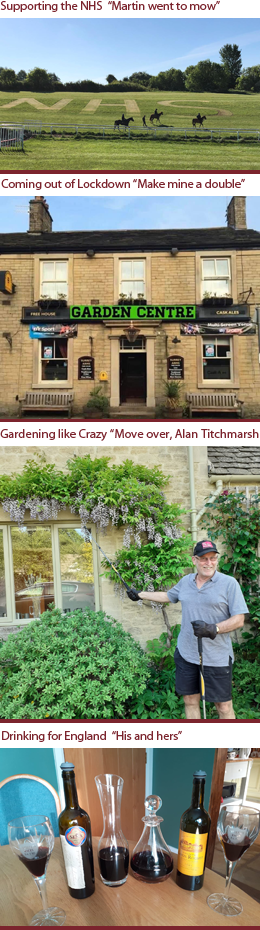
On a purely personal note, my wife and I have actually enjoyed the “staycation” of lockdown. There has been no rushing around the country and our mileage has never been lower. We’ve stayed well and healthy, with daily exercise burning off the calories from some fine wine tasting. The garden has never looked better. Finally, we’re lucky that some of our trainers have gone into overdrive on communication and there have been some magnificent photos and videos in circulation. Particularly well done to Martin Keighley in this regard as his videos are a work of art. Definitely a key part of keeping owners motivated, engaged and connected to the sport.


I am always interested to hear your views so please do leave a comment. If you can't see the comment box at the bottom of this post then navigate to the post using the right hand navigation or click here > and scroll to the bottom of the page. Look forward to hearing your views. Thanks very much for sharing them.


Sunday, 1 September 2019

How Many “Bad Apples” Are There in the Bloodstock Orchard, and Will They Now be Eradicated?


Back in the autumn of 2017, I wrote several blogs about integrity and corruption in racing, which included the bloodstock supply chain and sales houses. As a result of this I was invited to take part in the investigation instigated by the BHA and led by former senior policeman Justin Felice. I met up with him and colleagues on a couple of occasions and shared with them my own experiences encountered in buying racehorses over a 15-year period. Early in August, key stakeholders in racing met for a first review of his report, which was subsequently leaked by the Racing Post. Encouragingly, many of the recommendations I made to the study have been incorporated in the report, though I must emphasise that I haven’t yet read it myself, so this blog is based on the leaks. Further stakeholder discussions are taking place through September, and as soon as I’m able to obtain a copy of the full report I’ll do another blog on the subject.

Full credit should be given to the BHA for being prepared to launch this study. They came in for a fair bit of criticism and it is true to say that there are a few vested interests who were reluctant to acknowledge that major changes are needed. Some agents, trainers, managers of studs, bloodstock vendors and syndicators are guilty of “improper practices” which, if you are generous, you would say are unscrupulous and dishonest but if not you would say are criminal breaches of their fiduciary duties towards the purchasers of bloodstock, namely owners.

Felice is damning in his analysis of the industry and, quite rightly, calls for “transformational changes”. Although there is a code of practice dating back to 2004, subsequently amended in 2009, there hasn’t been a single recorded complaint in 15 years, which only encourages a number of resisters of change to remain in a state of denial over the corruption that occurs on a significant scale. Felice acknowledges this and believes that there is omerta – a culture of silence and of impunity. Bad, and even illegal, behaviour has long been tolerated by the industry. This isn’t some sort of minor, grubby, “Del Boy”-type misdemeanour; it is endemic behaviour up to and including the elite of breeders and agents who have shamelessly ramped prices and ripped off naïve and gullible owners. Addressing this behaviour is long overdue, and the real test of successful implementation of the Felice report will be the sharpness of the teeth of enforcement practices, the number of complaints that now surface and, in time, the banning and / or criminal prosecution of some of the culprits.

Many of the “improper practices” are widely known, and include:
  • Agents demanding a percentage of the sale price as totally unwarranted “luck money” from vendors. They pocket this for themselves and / or share it with the trainer. The owner knows nothing about it.
  • Dual representation, where the agent is acting for both purchaser and vendor, and charges a commission to both parties. Although representing both sides of the same transaction, at least one of the parties is unaware of the fact.
  • Secret profiteering, which is when the sales process is rigged through conspiratorial pre-agreed bidding up of a horse’s price. Vendors and agents conspire to inflate the price artificially above a pre-agreed amount and then split the difference between themselves.
  • Running up a price where the vendor bids against a buyer, without their knowledge, to obtain a higher value for their horse.
Anyone who is acting as an “agent” for a principal, e.g. an owner, must act in the principal’s best interests, otherwise they will be in breach of agency law and legislation such as the Criminal Law Act 1977, Fraud Act 2006 and Bribery Act 2010. In the light of the extensive use of the four “improper practices” described above, it is staggering that there haven’t been any prosecutions, but Felice is well aware that collusion and coercion in the bloodstock supply chain means that there is a huge reluctance to act and, indeed, a fear that by coming forward, individuals will be victimised by the powerful players who dominate at the sales. It is encouraging, therefore, that “transformational and once in a generation” changes are being proposed, inter alia:
  1. The BHA to be given jurisdiction over the currently unregulated bloodstock sector.
  2. The industry to operate under a proper, tougher Code of Conduct.
  3. Agents to be licensed. Those operating under such a licence will have to accept regulatory access to bank accounts if an investigation is taking place.
  4. Breach of the licence will lead to an agent losing it, together with bans and removal of access to the sales.
  5. Furthermore, breaches of the Rules of Racing – conduct prejudicial to horseracing – to be enforced on similar lines to the Financial Conduct Authority.
  6. Payment of luck money over, say, £250 to be deemed to be an inducement, and therefore criminal.
  7. Stop vendors bidding on their own horses beyond the reserves that they themselves have set. When a vendor bids beyond that reserve, the auctioneer to be required to announce it as a vendor bid.
  8. Binding agreements introduced between the BHA and sales houses to enable information sharing.
  9. Make it clear who is selling the horse. Sales houses to log and make public the full beneficial ownership of every horse due to be sold.
  10. Harmonisation of these changes to occur in Ireland and, in time, other jurisdictions such as France.
It will be interesting to see the progress made once consultation with stakeholders has been completed, and whether the industry is prepared to put its bloodstock sales houses properly in order. Zero tolerance of corrupt practices is required. Without it, the already fragile ownership base is likely to contract further and profound damage be done to racing’s integrity and reputation. At least it is encouraging that the study was completed and that there is a readiness on the part of the BHA to publish it and act on it.


I am always interested to hear your views so please do leave a comment. If you can't see the comment box at the bottom of this post then navigate to the post using the right hand navigation or click here > and scroll to the bottom of the page. Look forward to hearing your views. Thanks very much for sharing them.


Wednesday, 15 August 2018

A Major Milestone for The Owner’s Opinion – This is Our 150th Edition


Doesn’t time fly! We set up Owners for Owners in the summer of 2012 with the intention of helping owners come together to share the costs, risks and pleasures of racehorse ownership. As well as setting up the web site, we also launched our fortnightly blog, The Owner’s Opinion. With dedication, fortitude and on occasions liberal supply of strong red wine, we’ve managed not to miss an issue and built up a worldwide readership. On occasions the blog hits have been over 30,000, so hopefully those of you who read it find that we are both topical and sufficiently interesting to secure your continued readership.

It’s also incredible to reflect that since 2012 we have personally been involved in buying well over 50 horses and indeed at the moment are managing ownership of 23 horses at all ages from foals to 7-year-olds, in sole ownership, joint ownerships, partnerships, syndicates and a racing club and there aren’t many weeks when we’re not racing. With the exception of trainers we probably have as good an insight into racecourses and the owner experience as anyone, which is why we have participated in a number of working parties over the years, not least the BHA’s Strategy for Growth Pillar on Ownership and Bloodstock.

It is also no surprise that we’ve enjoyed both the highs and the inevitable lows of ownership. I’ll never forget the thrill of watching Lord Ben Stack lead the field of the Dante into the home straight, before sadly succumbing to colic a couple of years later – a gorgeous horse and much missed. On New Year’s Day this year, it was a similar thrill to see Acey Milan galloping the field into submission in the Listed 4yo Bumper at Cheltenham, and the dream is very much alive with this youngster. And also I’ll never forget the day at York Races when Buckle Street, ridden by the irrepressible Belinda Keighley, won the Macmillan Charity Race – absolutely no prize-money was gained by this win but it was a magnificent achievement, with Belinda raising an enormous amount of money for charity. The champagne celebrations in the paddock straight afterwards and throughout the evening were heroic. Brilliant days like these are what sustain us.

While trying to convey in the blog the mix of pleasures and frustrations that come from ownership, we’ve also had a campaigning edge throughout the 150 issues. The executive teams of a number of racecourses, particularly Newbury, Cheltenham before its improvements and some of the Arc tracks, became well aware of our lobbying for dramatic improvements in the owner experience. At heart, Owners for Owners is a very democratic, grass-roots body and we’ve long felt that the privileged top end of racing receives far too much money and attention, so we’ve lobbied hard for more prize-money and better facilities on the lesser days of racing. Some of our fellow syndicate organisers have also received a number of blasts as we’ve pushed hard for proper transparency and standards in syndication, which have now been adopted. Most of our campaigning has been well received, although we’ve doubtless made an enemy or two along the way – so be it. As a great friend of mine always says, “smooth diamonds don’t cut glass”.

And I’m sure the campaigning will continue. Indeed in the last blog I started to describe the new ownership strategy for British Racing and indicated that I was going to apply pressure for far more publicity about the strategy, while ensuring that the grass-roots owners had the right level of involvement in framing it particularly through the Racehorse Syndicates Association. I duly took this up with all the top executives in the industry and have received reassurances from them that this will now happen. Rest assured that The Owner’s Opinion will be holding their feet to the fire through late Summer and Autumn as this strategy is duly developed and published ….. Something tells me however that this won’t necessarily be a smooth journey. Don’t worry, I promise to keep you all posted.

On to the next 150!


I am always interested to hear your views so please do leave a comment. If you can't see the comment box at the bottom of this post then navigate to the post using the right hand navigation or click here > and scroll to the bottom of the page. Look forward to hearing your views. Thanks very much for sharing them.


Wednesday, 15 October 2014

Our Reaction to Booming Bloodstock Prices – Building the Pipeline in Different Ways


I’m writing this while listening to the Newmarket Tattersalls sale on the computer in the background. While it is obviously great for the vendors and the bloodstock industry to be harvesting such returns, it is definitely a head-scratcher. We have had trainers and agents looking closely at both National Hunt horses and the yearlings for the Flat at the various sales, and they are staggered by how many distinctly average horses are realising such enormous sums. At the Derby sale in Ireland (where we bought The Fugitive), there were numerous store horses going through for €150k+, none more so than the procession of Yeats’ progeny who were bought back in by the Magnier clan. Again at the Goffs Orby sale, records were broken and that momentum has continued through Tattersalls Book 1 and into Book 2. At our own level, there is just no way at all that we can chase these prices, not that we would want to. It is becoming increasingly clear that the dominance of NH owners with Messrs. Henderson, Mullins and Nicholls means that when they clash, the prices rapidly escalate to the ludicrous. Equally on the Flat, there is a platinum tier of global owners for whom money doesn’t matter.

So as a result of all of this, in Owners for Owners it is time to take stock. We’re not prepared to pay the sums required, and equally not prepared to lower the quality standards. What is our current thinking?

On the Flat we’ve commissioned Karl Burke and his family to work with us through Book 2 and then the Deauville Arqana sale next week, where we had tremendous success last year buying our two 90+ rated colts, Lord Ben Stack and Jolievitesse, both of whom have won and shown more than enough promise to indicate that they could easily be winning Group horses next season. All the owners now have the Dante meeting at York pencilled in their diaries, and we’ll be disappointed if one of them doesn’t go for the eponymous race itself. We’ve also joined forces with one of our key owners, Tim Dykes, who is investing in buying a number of fillies, both to race and to breed. By doing this we have been able to increase the budget to a maximum of £80,000 (inclusive of commissions etc.) and this is going to be a joint ownership: 50/50 between OfO and Tim. That way our owners can buy into the horse in shares for less than a total of £40,000. Bearing in mind how well we have done this year, please let me know as soon as possible if you’d like to be involved. At the moment the plan is to race the filly for two years and then we would breed from her. We’ll be giving owners the options of buying in either to race only, or to race and breed.

For NH, I was very struck by some comments made recently by Dan Skelton, who is pursuing what he termed, “the Marks & Spencer supply chain model of building a supply pipeline”. That is something that we are also going to pursue. Rather than just buying ready-to-race horses, such as those who have won their point-to-points, we are going to invest in a number of foals and have commissioned top agents Aiden Murphy and Gerry Hogan to act on our behalf at the upcoming foal sale at Tattersalls in Ireland, week commencing 10th November; and also Anthony Honeyball and Rachael Green. We would then have three horses in the pipeline and can make decisions as they develop whether we retain them so that they come in to racing in two to three years’ time, or sell them in the normal way as store horses. While it is higher risk, we’re hoping that by buying three we will have at least one or two able to race for us at a lower total price than investing in equally high-risk store horses or paying over the top for the winning Irish pointer.

As you can see, therefore, there is a shift of emphasis where over time we may accommodate not just buying policy around “buying to race” but also “breeding to race”. The intention is to do this in a balanced and judicious way while still working closely with our trainers and agents to buy horses able to come in to training on a much shorter timescale. As ever, I’ll be circulating details of the next opportunities for owners to become involved with us as co-owners. Watch this space!


I am always interested to hear your views so please do leave a comment. If you can't see the comment box at the bottom of this post then navigate to the post using the right hand navigation or click here > and scroll to the bottom of the page. Look forward to hearing your views. Thanks very much for sharing them.


Friday, 1 August 2014

The Two Key Decisions for an Owner – Part 1, Buying the Horse


In many ways the two key decisions about any horse are the initial one to acquire the animal, and then deciding when it is time to move him on to pastures new. One of the reasons we set up Owners for Owners is that we were dissatisfied on too many occasions by how these decisions were managed. Over the last six weeks we have experienced both, buying The Fugitive (3yo Flemensfirth gelding) and selling Houndscourt. In this blog I’ll use the example of The Fugitive to look at some of the shady practices in buying, and in the next one, how best to move a horse on.

Like many people we came into owning via syndicates. Some worked well, but others didn’t. There were two practices we really disliked. One was the syndicate manager picking up a horse that quite frankly not many people wanted. We’ve always hated the phrase, “a fun horse”, ever since. All too often they are useless and it costs no more to train a good one than a bad one. The other practice was that of adding a big margin on to the purchase price of a horse – indeed, often doubling or even trebling it.

So how do we go about buying a horse? We always like the trainer and the bloodstock agent to buy a horse together, against a well-defined specification. Ours was £50,000 hammer price maximum, top ten NH stallion, strong NH dam line with multiple winners at listed quality or above, no ancient mares, no first foals and with the scope and correctness for chasing. We went over to Tattersalls’ Derby Sale in Ireland in June with both Charlie Longsdon and our preferred agent for NH horses, Gerry Hogan, who is based over there and has his ear well and truly to the ground. They selected over 20 horses for detailed consideration, and we eventually bid on two. We let the first one go – a Presenting who was bought for €160,000 – but acquired the second, a gorgeous Flemensfirth from the family of Albertas Run. This is a real Cotswold staying type of horse (Charlie is based at Chipping Norton) because many of his close relatives have run for trainers such as Jonjo O’Neill and Nigel Twiston-Davies, with particularly fine records at both Cheltenham and Aintree.

Here are the details of what we paid. The hammer price was €52,000 and when you add on the Tattersalls commission (6%) + Gerry’s commission + vetting + LRT transport to the UK, the final cost was £46,320, which is what we are partnering him out at, with 1/6th shares costing £7,720. I find when buying horses that as a rule of thumb you need to add about 10% to cover the various related and unavoidable costs. In Owners for Owners we don’t add on any margins or mark-ups and we don’t charge anything for going to the sales, since we enjoy them so much.

So I decided as a comparison to have a look at two large syndicate companies to see what they would charge. One of them would have syndicated the horse at somewhere between £90,000 and £100,000 (so a sixth share would cost c. £15,000) while the other, on their policy, would have been well over £120,000 (sixth share c. £20,000). I just do not understand why anyone is prepared to end up either paying twice or three times the price or, looking at it the other way round, potentially halving the quality, with their money going to pay for lower quality stock but with high margins being maintained by the syndicate manager. I’ve actually discussed this with the self-appointed trade body for racing clubs and syndicates, and they are just not prepared to acknowledge that this is a completely unethical practice.

Obviously anyone can run any business in any way they like, and owners going into a commercial transaction should have their eyes wide open, and as always, “caveat emptor” – let the buyer beware. The problem though, I think, is that some racing managers of syndicates are using this practice to conceal profit margins. Personally I believe that if there were a code of practice for syndicates and racing clubs it would outlaw it, and require all racing managers to provide explicit and transparent breakdowns of costs of purchase and also their ongoing charges. If the syndicates then continued to ramp the price of the initial purchase, I think they would lose business rapidly. Transparency would drive much-needed changes in commercial practice.

What do you think? You have been warned!


I am always interested to hear your views so please do leave a comment. If you can't see the comment box at the bottom of this post then navigate to the post using the right hand navigation or click here > and scroll to the bottom of the page. Look forward to hearing your views. Thanks very much for sharing them.