Showing posts with label racehorse ownership. Show all posts

Sunday, 1 November 2020

Sole Leadership of an Industry-Wide Ownership Strategy Needs to be Taken Away from the Racehorse Owners Association

Regular readers of this blog and also the one on www.keepownersinracing.com will know that there has been a critical need for an industry-wide ownership strategy, structured in a way that incentivises and motivates owners to remain in the sport, while attracting new ones. Back in 2017, it was agreed by racing’s leadership that this strategy would be developed by the Racehorse Owners Association, but with collaborative work groups linking together all the important players so that there would be a coherent approach to ownership, and one that would be able to launch major initiatives impacting racecourses, trainers, owner-breeders, syndicators and the whole ownership population. The process that the ROA has pursued, under the leadership of their chief executive Charlie Liverton, has unfortunately been an heroic failure, despite its being funded to the tune of £1.2m by the Horserace Betting Levy Board. Almost no-one in the industry can tell you what the Ownership Strategy actually means, there is no commitment to it (not least because no-one knows what it is) and the strategy process would fail any test of good design. Indeed, the leading academic in this area, Richard Rummelt, of the University of Southern California, describes many strategies as “garbage”, full of “fluff and flannel” and laundry-lists of “statements of desire” with no chance whatsoever of being implemented. He could have been reading the bumf put out by the ROA.

In the most recent blogs on KOIR, we have come to the conclusion that the Ownership Strategy needs to be taken away from Charlie Liverton and handed back to a cross-industry working group of the committed and the competent. We would go even further than that, calling for his replacement. Here are two blogs that convey the argument and the flavour of what we are advocating.

Ownership Strategy, Part 2 – Testing and Tracing the ROA’s Six-Point Covid Plan

What has your reaction been to the last eight months? Frustration on seemingly incoherent and inconsistent policy; irritation at the endless procrastinations and prevarications; anger at constant ineptitude in implementation of initiatives, “too little and too late”; amazement at the fortunes being paid out to armies of management consultants; incredulity at the disarray of high-ranking leaders and their inability to lead; wonderment at the endless TLAs (three-letter acronyms) of bureaucracies and working groups producing ever more confusing and contradictory reports? All compounded by a lack of scrutiny of actions, results and accountabilities. And that’s just the Racehorse Owners Association and their non-existent / inept leadership of an Industry Ownership Strategy that was promised back in 2017 (we’ll pass over your views about Dido Harding and Test and Trace).

You’ll know from the Keep Owners in Racing blogs that we campaigned hard for the release of a meaningful Ownership Strategy. We understand that over £1.2m was invested in it through funds from the Horserace Betting Levy Board. Portas Consultants supported it, and even at bargain basement rates (for consultants) of £1,000 per day, that represents at least five years of effort. It seems reasonable to expect strategic outputs of the highest quality for that investment. Indeed, my co-author Ged Shields has been expecting a “Sistine Chapel of an ownership strategy”, bearing in mind how long it has taken and the cost involved. We’ve been requesting sight of the Ownership Strategy for a long time, and Ged and I joke that its publication has been delayed more times than the latest James Bond movie.

Back on 25th August, when Nick Rust announced the nine goals of his Recovery Plan, it was promised “within weeks”. The lockdown was ordered by the Prime Minister on 23rd March and we’re now 220 days on from that momentous announcement. Finally, on 28th October the ROA released a six-point action plan aimed at retaining owner investment during the ongoing Covid-19 crisis. Dear oh dear! Such a long wait for so little substance. Few meaningful initiatives; a complete absence of reference to the £1m+ funding exercise with Portas; no project management structure to design and implement actions; just lots more words and waffle, rather than solutions.

Reluctantly, we’ve come to the conclusion that it’s time to take the sole leadership of this strategy away from the chronically under-achieving ROA. For the good of the sport, it is absolutely vital that a task force of the committed and capable take charge immediately of the number one priority of retaining owners. As far as the CEO, Charlie Liverton, is concerned – sink him, park him, move him or sack him. Just move this prime blocker away from the strategy and stop the ongoing damage. Put him out of his misery.

We said in Blog 24 that “We’ll be Back”. I don’t think we expected to return quite so quickly. We’re determined to do everything possible to drive significant change in the leadership and governance of the Ownership Strategy. Stay tuned!

What Did the Romans Ever Do For Britain – or the ROA, For That Matter?

One of my favourite sketches from Life of Brian is the one where a bunch of conspirators is being challenged by John Cleese to denounce the Romans. The repeated refrain of “What have the Romans done for us?” is interspersed with a long list including the aqueduct, sanitation, roads, irrigation, medicine, education, health, wine, baths, public order and peace. Not a bad portfolio of benefits; “But apart from that, what have they done for us?”

Being a rather irreverent fellow, I was wondering what conclusions I would come to if I raised the same question about the Racehorse Owners Association. At one level you can regard them almost as a hospitality organisation or members’ club setting up social events, visits and marquees on big racedays where aged members can escape the elements and at least sit down in a little more comfort than is often provided by the racecourses. “But apart from that ….?” They produce the Owner Breeder magazine, offer third party liability insurance cover, discounts on BHA fees, free priority parking at the races, the racecourse admission scheme, owner sponsorship, occasional ROA owners’ jackpots and similar types of benefit.

Quite a good set of offerings, and by focusing on them they have attracted 8,000+ members at an annual sub of a couple of hundred pounds. Their annual turnover in 2019/20 was £2.6m, although they had a deficit of £222k.

“But apart from that ….?” What else do they do? They have certainly been in existence a long time, with three themes over the decades consistently receiving some focus: pressure for better minimum prize-money (hardly a success), trying to establish a credible long-term financial plan for racing (now in tatters), and working for the common good and leaving the factionalism of the past behind it (not sure that has been the case over the last few years, judging by ROA outbursts in the Racing Post).

A central question is whether they are genuinely representative of owners, and whether they have sufficient legitimacy to have taken charge of an Ownership Strategy which has not yet made its appearance despite being funded by £1.5m from the Horserace Betting Levy Board and the Racing Foundation. As we worked through the 100-day Keep Owners in Racing campaign, many of the individuals we’ve interviewed expressed strongly critical views about the endless delays and inadequate involvement in the framing of what should have been a genuinely cross-industry strategy. This has certainly damaged the credibility of the ROA and its leadership.

When Life of Brian was released in late 1979, its satire was deemed to be very controversial – so much so that it was prohibited in countries such as Ireland and Norway. This notoriety was a godsend for marketing, with posters apparently appearing in Sweden that read: “So funny it was banned in Norway”! While the ROA wouldn’t have gone that far, I’m sure they would have preferred it if Keep Owners in Racing had not banged the drum for owners with such tenacity. Never mind, while we’re waiting for the promised land of the Ownership Strategy we can at least whistle along to Look on the Bright Side of Life as ownership numbers and investment start to plummet.


I am always interested to hear your views so please do leave a comment. If you can't see the comment box at the bottom of this post then navigate to the post using the right hand navigation or click here > and scroll to the bottom of the page. Look forward to hearing your views. Thanks very much for sharing them.


Monday, 1 June 2020

“Under Starter’s Orders … and We’re Off” (Hopefully). Racing Resumes and Everyone is Thrilled, but Now the Real Challenges Begin for British Racing.


Today racing is highly likely to get under way again at Newcastle, and it will be the first race meeting since the sport was closed down after 17th March. Once the seriousness of the pandemic is over, there will probably be a racing quiz question to name the final horse to win before lockdown – it came from the yard of one of our trainers, Charlie Longsdon, and was Glencassley, a 5yo in a Class 5 bumper, ridden by Aidan Coleman, and winning the princely sum of £2,599.20. Rarely will a Class 6 mile handicap at Newcastle have received so much attention, and doubtless huge viewing figures and betting investments. May everything go smoothly and safely.

British Racing has not had a particularly good reputation in the past for burying its differences, collaborating and co-operating, but the Resumption of Racing Group led by the BHA has excelled over the last few months and the way in which they have tackled the complexities and challenges of getting racing back on the road has been exemplary. Multiple work streams were launched, tasks prioritised and allocated to lead individuals and then the highly detailed race planning, reprogramming and creation of safety protocols were addressed in a thoroughly professional and robust manner. Everyone in the sport should take their hats off to the “Gang of Four”, namely Brant Dunshea, Chief Regulatory Officer; Dr. Jerry Hill, Chief Medical Adviser; Ruth Quinn, Director of International Racing and Racing Development; and Richard Wayman, Chief Operating Officer, for all their hard work while managing successfully to keep the stakeholders on board and the government supportive of racing’s resumption, albeit behind closed doors. More radical change has been driven forward over this couple of months of crisis than would have been achieved in years under a less collaborative way of working.

There are many messages to take out of this period, and a key learning is for racing to continue with this collaborative and far more proactive style of working … not least because the really hard work now has to commence. The implementation of the Resumption of Racing Plan doesn’t mark the end of the activity, but the beginning of the far more complex Recovery of Racing Plan. There is a huge challenge for the sport over the next few years as it is inevitable that there will be contraction in ownership ranks, racecourse attendances, trainers, stable staff and all the other participants in “racing’s ecosystem”. The unfortunate parallel I believe is to look at the impact of the financial crisis in 2008 / 2009. In the following six years there was a straight decline every year in the number of owners and horses in training. In total 17% of owners quit the sport and the horse population contracted by 11%. The bloodstock industry almost collapsed, with the middle and lower market horses almost impossible to sell. The financial impact of this on the whole sport was huge and ran into many millions of pounds of lost investment. Why should it be any different after the pandemic crisis? The global economy may have been pumped up with liquidity, but two recent quotations show the crisis that is coming. “We are likely to face a severe recession, the likes of which we haven’t seen … it’s not obvious there will be an immediate economic bounce-back”, Rishi Sunak, Chancellor. Sir Howard Davies, Chairman of RBS, said: “Three or four weeks ago, the assumption was that there was a pent-up economy desperate to get out. All it needed was the government to say, ‘the water’s not too cold’, and we’d jump back in. Now we’re realising there are all kinds of friction points, which means a V-shaped recovery is much less plausible. The recovery is going to be very slow.”

A fundamental question therefore for our sport is whether there is any consideration at all even being given at the moment to a Recovery of Racing Plan. An immediate short-term plan is essential if owners are to be motivated to remain in the sport and invest in future racehorses. It is only too easy to imagine many owners deciding to suspend or terminate their commitment to invest, and the results of the sales season will confirm or disprove that statement. My challenge would be for the industry to start the first phase of a plan from 1st June to the final day of Tattersalls Book 4 Yearling Sale on 17th October. What should be done in that 139 days? Once racing is through that period, it then needs to drill down into a three-year Recovery and Growth Plan. Sorry to sound so pessimistic but without this, I believe a very serious economic crisis lies ahead for the sport.

Very encouragingly, the seeds of recovery can be found in the way of working of the Resumption of Racing Group. The whole race programme, fixture list and rescheduling of the Classics has been a huge undertaking and achieved, successfully, in less than ten weeks. it is not an over-statement to say that in normal times this wouldn’t have occurred in ten years. That sort of radical change needs to become the keynote for the recovery plan. Another example – something that Owners for Owners has been proposing for ages – is the need to rebalance prize-money from the top tier of the sport to the grass roots. Faced with a considerable reduction in prize-money and levy funding due to the negative impact on racing income of racing behind closed doors, reduced fixtures and lost media rights, it was inevitable that prize-money would have to be slashed, but rather than spread the pain equally the BHA has done everything possible to support the grass-roots. The pain is being felt most at the top of the sport, as the chart below for Flat prize-money clearly shows. 84% of all horses in training on the Flat race at Class 4 or below, with 46% of the horse population at Class 6 level where the drama and clamour of the sport is hardly evident. This realignment of prize-money ought to be a permanent feature and be one pillar of the recovery plan.

Minimum Prize Values Introduced from 1st June 2020


Class 2-year-old 3-year-old-plus
Old Minimum Value New Minimum Value % Old Minimum Value New Minimum Value %
1(G1) £ 150,000 £  75,000 50% £  200,00 £  100,000 50%
1(G1) £  65,000 £  37,000 57% £   90,000 £    52,000 58%
1(G3) £  40,000 £  25,500 64% £   60,000 £    37,000 62%
1(Lstd) £  25,500 £  17,500 69% £   37,000 £    25,500 69%
2(H) £         - £         -
£   45,000 £    40,000 89%
2 £  14,000 £  11,500 82% £   19,000 £    15,000 79%
3 £  10,000 £   9,000 90% £   11,500 £    10,400 90%
4* £    6,100 £   6,100 100% £     7,250 £      7,250 100%
5* £    4,500 £   5,400 120% £     4,500 £      5,400 120%
6* £    3,500 £   4,300 123% £     3,500 £      4,300 123%


The ownership experience from June onwards is likely to be critical in owner retention. Unfortunately at the moment owners are unable to attend racecourses and see their horses in action, frustrated at the difficulties of actually getting horses into races with huge entries, forbidden to attend social gatherings with fellow owners and restricted by trainers from access to yards while having to follow all the required social distancing measures. The bottom line is that the bills remain the same, but the ownership experience is significantly curtailed. That is the demotivating reality that confronts the owners of racehorses. It is absolutely vital in the short term 139-day plan that racing, and particularly racecourses and trainers, come up with compensatory benefits to ensure that owners remain sufficiently motivated and connected to the sport to continue in it. This will be the subject of the next blog, by which time it is to be hoped that some encouraging initiatives will be under way.

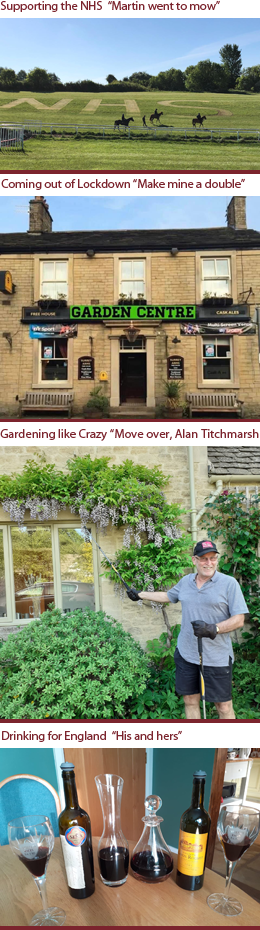
On a purely personal note, my wife and I have actually enjoyed the “staycation” of lockdown. There has been no rushing around the country and our mileage has never been lower. We’ve stayed well and healthy, with daily exercise burning off the calories from some fine wine tasting. The garden has never looked better. Finally, we’re lucky that some of our trainers have gone into overdrive on communication and there have been some magnificent photos and videos in circulation. Particularly well done to Martin Keighley in this regard as his videos are a work of art. Definitely a key part of keeping owners motivated, engaged and connected to the sport.


I am always interested to hear your views so please do leave a comment. If you can't see the comment box at the bottom of this post then navigate to the post using the right hand navigation or click here > and scroll to the bottom of the page. Look forward to hearing your views. Thanks very much for sharing them.


Wednesday, 15 August 2018

A Major Milestone for The Owner’s Opinion – This is Our 150th Edition


Doesn’t time fly! We set up Owners for Owners in the summer of 2012 with the intention of helping owners come together to share the costs, risks and pleasures of racehorse ownership. As well as setting up the web site, we also launched our fortnightly blog, The Owner’s Opinion. With dedication, fortitude and on occasions liberal supply of strong red wine, we’ve managed not to miss an issue and built up a worldwide readership. On occasions the blog hits have been over 30,000, so hopefully those of you who read it find that we are both topical and sufficiently interesting to secure your continued readership.

It’s also incredible to reflect that since 2012 we have personally been involved in buying well over 50 horses and indeed at the moment are managing ownership of 23 horses at all ages from foals to 7-year-olds, in sole ownership, joint ownerships, partnerships, syndicates and a racing club and there aren’t many weeks when we’re not racing. With the exception of trainers we probably have as good an insight into racecourses and the owner experience as anyone, which is why we have participated in a number of working parties over the years, not least the BHA’s Strategy for Growth Pillar on Ownership and Bloodstock.

It is also no surprise that we’ve enjoyed both the highs and the inevitable lows of ownership. I’ll never forget the thrill of watching Lord Ben Stack lead the field of the Dante into the home straight, before sadly succumbing to colic a couple of years later – a gorgeous horse and much missed. On New Year’s Day this year, it was a similar thrill to see Acey Milan galloping the field into submission in the Listed 4yo Bumper at Cheltenham, and the dream is very much alive with this youngster. And also I’ll never forget the day at York Races when Buckle Street, ridden by the irrepressible Belinda Keighley, won the Macmillan Charity Race – absolutely no prize-money was gained by this win but it was a magnificent achievement, with Belinda raising an enormous amount of money for charity. The champagne celebrations in the paddock straight afterwards and throughout the evening were heroic. Brilliant days like these are what sustain us.

While trying to convey in the blog the mix of pleasures and frustrations that come from ownership, we’ve also had a campaigning edge throughout the 150 issues. The executive teams of a number of racecourses, particularly Newbury, Cheltenham before its improvements and some of the Arc tracks, became well aware of our lobbying for dramatic improvements in the owner experience. At heart, Owners for Owners is a very democratic, grass-roots body and we’ve long felt that the privileged top end of racing receives far too much money and attention, so we’ve lobbied hard for more prize-money and better facilities on the lesser days of racing. Some of our fellow syndicate organisers have also received a number of blasts as we’ve pushed hard for proper transparency and standards in syndication, which have now been adopted. Most of our campaigning has been well received, although we’ve doubtless made an enemy or two along the way – so be it. As a great friend of mine always says, “smooth diamonds don’t cut glass”.

And I’m sure the campaigning will continue. Indeed in the last blog I started to describe the new ownership strategy for British Racing and indicated that I was going to apply pressure for far more publicity about the strategy, while ensuring that the grass-roots owners had the right level of involvement in framing it particularly through the Racehorse Syndicates Association. I duly took this up with all the top executives in the industry and have received reassurances from them that this will now happen. Rest assured that The Owner’s Opinion will be holding their feet to the fire through late Summer and Autumn as this strategy is duly developed and published ….. Something tells me however that this won’t necessarily be a smooth journey. Don’t worry, I promise to keep you all posted.

On to the next 150!


I am always interested to hear your views so please do leave a comment. If you can't see the comment box at the bottom of this post then navigate to the post using the right hand navigation or click here > and scroll to the bottom of the page. Look forward to hearing your views. Thanks very much for sharing them.


Sunday, 15 May 2016

How to “segway” from Beer Consumption to Growing Racehorse Ownership in British Racing – A Further Note on the BHA’s Growth Strategy


I was delighted to read of a research study done by the Mediterranean Neurological Institute concluding that moderate daily beer consumption reduces the risk of heart and circulatory diseases by a quarter. Apparently the phenols in the flavour act as an antioxidant and anti-inflammatory and also protect the body against viruses. Here in the Hawling Institute we have also concluded through even more extensive research over many years that combining this with red wine drinking guarantees receipt of a telegram from the Queen on reaching your century.

So a number of our owners put this latest finding into practice this week at York for the Dante meeting, not least celebrating a game 4th by our horse Jolievitesse on the opening day. Readers of this blog will know that I believe York Racecourse sets the bar for the total owner and racegoer experience. They are continuing to invest heavily at the track, with prize-money this year increasing to £7m despite a £200,000 decrease in levy funding. Last year they achieved record turnover and attendances. Their £60m-plus investment in facilities for horses, horsemen and racegoers over the last 20 years has paid handsome dividends. Jolievitesse’s race was only Class 4 but had a prize fund of £15,000 with £9,700 for the winner but still £721 for the 4th. The 20-runner field will have guaranteed significant betting and substantial levy contribution. It is this virtuous circle that racing is striving to achieve on a broader basis.

We weren’t however debating racing politics after this fine run, but there was a fair bit of discussion about how good the York experience is, particularly when you are staying in country hotels and dining in excellent restaurants. If you’re in the area, do visit The Crown Inn at Roecliffe. I don’t know of any course that offers such good value, with champagne at £30 a bottle and Theakston’s best bitter at £3.30 a pint, readily available in their new bar set up to offer local beers. Indeed York makes a big point of the partnerships they have developed with local suppliers of beef, smoked salmon, trout and fine cheeses from Ryedale, Wensleydale and Hambleton. I bet you feel hungry now! Courses can do a lot more to showcase local produce. Cheltenham did so at the October meeting and it was a great success.

The racing at York, as usual, was top-class, not least the superb runs by So Mi Dar in the Musidora and Wings Of Desire in the Dante. John Gosden came up with a nice comment about his now Derby favourite, that what he most enjoys is “eating and sleeping”. If you add in drinking beer and wine as well, it would cover most of the Owners for Owners network!

So York racecourse definitely demonstrates what can be done to enthuse racehorse owners. At the BHA forum I attended at Newbury on 1st March, Richard Wayman made a typically strong presentation in which he balanced discussion on the disappointing contraction in the UK ownership base (horse population down 9% from 2008; steady decline in registered owners over the same period, down 17%) and an analysis of its causation (the poor economics of ownership in the UK; a need to strengthen owner engagement; insufficient promotion of ownership, not least in syndicates; and needlessly complex ownership structures, systems and fees) with an outline of a number of practical initiatives to improve the situation.

Obviously the key to prize-money is tied in with levy replacement and capturing racing’s rightful contribution from the offshore bookmakers. I’ve covered that before in the blog, so won’t touch on it again. Richard, though, emphasised that it is not all about prize-money and stated strongly that owners must feel valued within racing, and clearly trainers and racecourses are at the heart of that. There is also apparently going to be a major innovation to streamline ownership administration from early 2017 as well as a big push on ownership, particularly with a campaign to promote syndication. There will be a central ownership hub, close liaison with racecourses and the introduction of a code of conduct for syndicates, thereby ensuring far more transparency and helping prospective owners make a more informed choice.

As this was right at the heart of why we set up Owners for Owners, we feel vindicated. Time to reflect on this with a couple of pints of Donnington’s Best Bitter in The Plough at Ford, my local watering hole just round the corner from Martin Keighley’s stables. Maybe it’s time to think about a Plough partnership.


I am always interested to hear your views so please do leave a comment. If you can't see the comment box at the bottom of this post then navigate to the post using the right hand navigation or click here > and scroll to the bottom of the page. Look forward to hearing your views. Thanks very much for sharing them.


Saturday, 15 August 2015

Incompetence or Corruption – Where Do You Draw the Line on Ethical Practices?


I always remember a lovely story told by the inimitable cricket correspondent, Henry Blofeld. Apparently on one occasion when he was entering Australia at Sydney Airport, he was stopped at Immigration to answer a number of questions. When asked, “Do you have a criminal record?”, his reply was, “My dear old thing, I didn’t realise it was compulsory!”

I don’t know if I was chuckling quite so much when I read on the Racing Post web site this week an almost unbelievable story concerning the Australian trainer, Dean Howard, who was suspended for 18 months after selling a horse without the consent of the owners, and keeping a chunk of the sale proceeds for himself. Apparently he sold the horse, Convincable, to Hong Kong without the owners’ knowledge, before informing them of a lower final sale price. He then kept the difference. What I find even more unbelievable is that he only got 18 months!

Maybe it depends on the Australian interpretation of criminality! The serious issue is that a lot of ownership and partnership problems that can occur are actually a breach of agency law. In most instances the owners are the principals and the bloodstock agents and trainers are merely agents, covered by well-established common law principles and precedents. Agents must act in the best interests of their principals. Alas, that all too often isn’t the case. So I decided to think about problems that I have encountered in the last decade or so of owning horses, and have listed ten examples below. They are numbered from 1 to 10. Where would you draw the line in your interpretation of a breach by the agent? I suspect a lot of you will start to have concerns from 1 onwards!! Unfortunately all of these are relatively common examples.

I just don’t believe that the racing mind-set is to protect owners properly, while seeking out value for money at every opportunity. Indeed, one of the very top NH owners believes that practices such as those listed below are “illegal taxes on owners”.

  1. Trainer uses the same vet for all his horses, but the owner is charged at the standard vet rack rate; no reductions and no rebates for annual volumes, regardless of the profit to the vet over the year.
  2. Inaccuracies on the trainer’s recording of full training fees vs. lower fee out of training, box rest etc.
  3. Vet automatically doubles the cost to the owner of buying in proprietary drugs. Adds no value whatsoever.
  4. Trainer takes a full box to the races and then charges each owner the mileage rate as though for a single horse. Similarly, charges full costs of a visit to a sale (flights, hotels, meals etc.) to each owner for whom he buys a horse at that sale.
  5. Trainer charges for a treatment such as use of a cold-water spa, swimming pool or treadmill, even though the horse has not received the treatment.
  6. Syndicate manager has a “free share”; no cost for this but participates in all benefits / prize-money.
  7. Horse bought by a syndicate manager from a family member’s stud farm. Horse has a chronic wind problem.
  8. Syndicate manager, inept on accounts, manages to “lose” £8,000. “Forgets” to register for VAT.
  9. Syndicate horse entered into a sale without the approval of the owners. Doesn’t meet its reserve. Sold privately the same day by the manager at a lower price to a “contact”. That person sells the horse on the next day for twice as much. Zero owner involvement, discussion or opportunity to make a bid.
  10. Syndicate manager doubles the purchase price of the horse on syndication, thereby immediately halving the value of the asset purchased by the owners, while making himself 100% profit for doing nothing.
You can see why we set up Owners for Owners. We make sure that none of our owners are ripped off. Occasionally mistakes occur, but we’re now in the fortunate position where our relationships with trainers and agents are excellent. However, that doesn’t mean that everything is perfect, and for example the way vets charge is a persistent niggle, and something which from time to time we’ve had to challenge.

I’ve just been invited to take part in an ROA working party, tasked with producing a code of conduct for syndicates. Alas, I’m not going to find it too difficult to come up with real-life examples of incompetence and, I’m afraid on occasion, corruption. It will be interesting to see the appetite for where the line is drawn in the ethical sand. I’m certainly going to be at the robust end of the scale, and would like to see far more transparency and demanding service standards required from the various agents.


I am always interested to hear your views so please do leave a comment. If you can't see the comment box at the bottom of this post then navigate to the post using the right hand navigation or click here > and scroll to the bottom of the page. Look forward to hearing your views. Thanks very much for sharing them.